J. Northw. Atl. Fish. Sci., Vol. 57: 1-33
Review article
Daniel G. Boyce*1, Frédéric Cyr2, Susanna Fuller3, Kathryn E. Schleit3, Rick M. Rideout4
1 Wild Ocean Research, Cow Bay, Nova Scotia, Canada
2 Centre for Fisheries and Ecosystem Research, Fisheries and Marine Institute of
Memorial University, St. John’s, Newfoundland and Labrador, Canada
3 Oceans North, Halifax, Nova Scotia, Canada
4 Northwest Atlantic Fisheries Centre, Fisheries and Oceans Canada, St. John’s,
Newfoundland and Labrador, Canada
*Corresponding author: dboyce@dal.ca
Boyce, D.G., Cyr, F., Fuller, S., Schleit, K.E., Rideout, R.M. 2026. Exploring the impacts of climate change on fisheries resources within the NAFO Convention Area. J. Northw. Atl. Fish. Sci., 57(2): 1–33. https://doi.org/10.2960/J.v57.m751
Abstract
Climate change is impacting marine species, populations, ecosystems, and the fisheries and communities they support. While there is broad agreement that climate change should be considered when assessing the status of exploited stocks and making harvest decisions, there is little consensus on how to do so. This study aims to increase knowledge and awareness of climate change and its impacts on fisheries and ecosystems across the Northwest Atlantic Fisheries Organization (NAFO) Convention Area, following NAFO’s 2023 resolution to address the effects of climate change on NAFO fisheries and to provide guidance on adaptation and mitigation in support of climate-resilient fisheries. A comprehensive literature review was undertaken, supplemented by analyses of projected climate change and its ecological impacts across the NAFO Convention Area. Various climate changes are observed and projected, including surface and bottom warming, deoxygenation, acidification, reduced sea ice, and altered mixing and nutrient flux. These climate changes are associated with a range of ecological shifts, including altered productivity and mortality rates, geographic range shifts toward more northerly and/or deeper waters, earlier ages at maturity but reduced body sizes, shifted phenology, and trophic mismatches, with disproportionate impacts on high-trophic species. Half of the species examined in the NAFO Convention Area are at high risk of being adversely affected by anthropogenic climate change over the next 75 years. In many areas, climate impacts on fisheries living resources are already occurring or are projected within the next few decades. However, a notable lack of information on climate change impacts was observed for some species, leading to uncertainty in climate risk assessments. Interpreting these findings within the NAFO fisheries management context and in light of its ecosystem approach to fisheries roadmap, several approaches to addressing the impacts of climate change on NAFO fisheries are discussed.
Keywords: Northwest Atlantic Ocean, climate change, climate vulnerability, climate risk, fisheries, fisheries management, Northwest Atlantic Fisheries Organization, climate impacts
PDF, Supplementary Materials
Download Citation Data

Citation to clipboard
 Reference management software (Endnote, Mendeley, RefWords, Zotero & most other reference management software)
LaTex, BibDesk & other specific software
Introduction
The ocean climate varies naturally at seasonal, decadal, and multidecadal scales, but for the past century, it has been systematically changing due to human activities (IPCC, 2019). Seasonal and decadal-to-multidecadal climate variation and its effects on marine life can be immense but short-lived (Behrenfeld et al., 2006; Martinez et al., 2009; Boyce et al., 2010). In contrast, longer-term, anthropogenically driven climate changes tend to be of smaller magnitude year over year but can cause abrupt, unanticipated and lasting effects on marine life (Scheffers et al., 2016). Further, shorter-term climate variation and longer-term climate changes are increasingly interacting to create shifting patterns of seasonality and more frequent and extreme climate fluctuations (Nin et al., 2009; Wang et al., 2019; Shin et al., 2022).
These climate changes affect marine life through a complex web of pathways, posing an unprecedented risk to food and economic security for billions of people worldwide (Barange et al.,, 2010; Hollowed et al.,, 2013; Poloczanska et al.,, 2013; IPCC 2014; Gattuso et al., 2015; Lotze et al., 2019; Boyce et al.,, 2020a). Climate change is expected to have significant effects on the distribution, yield, and productivity of marine fishing (Bryndum-Buchholz et al., 2018; Free et al., 2019; Lotze et al., 2019; Boyce et al., 2020a). Nevertheless, studies also suggest that appropriate management can improve fisheries status (Gaines >et al., 2018; Hilborn et al., 2020) and offset adverse climate change effects—in some situations, compensating for harmful effects and amplifying positive effects (e.g., Le Bris et al., 2018). There is an urgent need to account for both short-term variability and long-term trends in the climate system when assessing and managing marine fisheries to achieve sustainable outcomes now and in the future. This is particularly challenging for the Northwest Atlantic, one of the most dynamic regions of the global ocean that exhibits huge seasonal and decadal-to-multidecadal variation (Visbeck et al.,, 2001) and is a hotspot of climate change (Hurrell et al.,, 2006; Delworth et al.,, 2016).
The extent to which fisheries management strategies in the North Atlantic account for climate change varies but is generally low (e.g., Boyce et al., 2021; Kulkaet al., 2022; Pepin et al., 2022). The limited climate consideration in the North Atlantic, and elsewhere, may contribute to the shortcomings of many fisheries management approaches worldwide (Garcia and Grainger 1997; Worm et al., 2009; Brander 2010; Pershing et al., 2015) and associated fish population collapses and delayed recoveries (Baum et al., 2003; Myers and Worm 2003, 2005; Worm et al., 2009; Hutchings et al., 2010). Delays in implementing climate adaptation measures are expected to exacerbate these risks (Melvin et al., 2016), and there is an urgency to understand how fisheries can be managed in a climate-considered manner (Lawler et al., 2010; Pinsky and Mantua 2014; Gattuso et al., 2015; Busch et al., 2016; Ojea et al., 2017; Holsman et al., 2019). As a result, the 2021 United Nations (UN) General Assembly Sustainable Fisheries Resolution A/RES/76/71 calls on regional fisheries management organizations (RFMOs) to consider the profound implications of climate change for fisheries, as well as the science and adaptive management actions likely to be required in the future. Likewise, at the 35th meeting of the United Nations Food and Agriculture Organization’s (FAO) Committee on Fisheries (COFI), an emphasis was placed on the need to increase the knowledge and awareness of climate change impacts in fisheries and aquaculture and the need to be able to provide climate-resilient fisheries advice and management. In 2023, NAFO adopted a resolution (NAFO/COM 23-13) on addressing the impacts of climate change (NAFO, 2023); (see SI for details of the resolution). To paraphrase, the resolution outlined NAFO efforts to summarize and evaluate current and projected climate changes and their impacts on ecosystems, as well as target and non-target species across the Northwest Atlantic region, paying specific attention to the Northwest Atlantic Fisheries Organization (NAFO) Convention Area (Fig. 1); consider how climate change could be more explicitly considered in decision-making via the NAFO Ecosystem Roadmap; and identify data gaps and research needs as they relate to climate impacts and adaptation within NAFO.
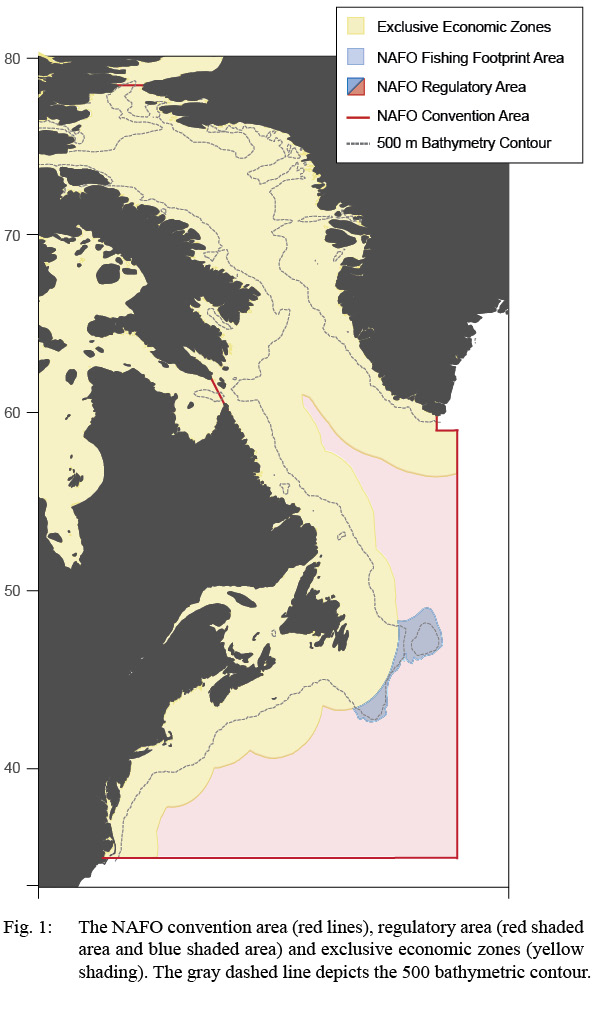
Fig. 1
This study supports this work by 1) reviewing the scientific basis for climate change and its impacts on Northwest Atlantic fisheries resources, 2) conducting a targeted assessment of climate impacts and risks on fisheries living resources within the NAFO Convention Area, 3) proposing pathways for increasing climate change considerations within Northwest Atlantic Fisheries Organization (NAFO) assessments and management measures, and 4) exploring how climate variability and change could be more explicitly integrated within NAFO’s current EAF management system (Koen-Alonso et al., 2019). To our knowledge, this is the first synthesis of current and future climate changes and their impacts, explicitly focused on advancing climate resilience within NAFO.
Our study focuses on Northwest Atlantic ecosystems and the 14 species (hereafter referred to as ‘NAFO species’) for which NAFO’s Scientific Council has previously provided advice, either as part of a recurring assessment schedule, as one-off requests, or as advice of their own accord (i.e. not requested). For some species, many stocks are defined within the Convention Area. Some stocks are managed by NAFO (e.g., when distributed in whole or in part outside national EEZs), whereas others are managed by the Coastal States. We focus on the complete distribution of species within the NAFO Convention Area, hereafter referred to as the NW Atlantic, rather than the stock structure. By examining the potential impacts of climate change at a large spatial scale, it is possible to infer effects at smaller scales (e.g., at the stock level) and monitor the potential south-to-north progression of these impacts.
Climate change and its impacts on NW Atlantic ecosystems:
past trends and future outlook
This study reviews over 800 publications on the impacts of climate change on fisheries living resources—species, populations, and ecosystems (see Supplementary Information and Table S1 for search criteria and summary tables); it organizes them into climate change, climate impacts, and climate futures.
Climate changes: A physical and biogeochemical basis
The NW Atlantic is a climate change hotspot (Boyce et al., 2010, 2020b; Hutchings et al., 2012; Loder et al., 2013; Niemi et al., 2019; Alexander et al., 2020; DFO 2022). Since 1900, surface waters across the NW Atlantic have warmed more rapidly (0.93°C; S.D. = 0.47°C) than the global average (Boyce et al., 2020b), with 2012 and 2023 being anomalously warm (Bernier et al., 2023). Rapid warming has occurred in the Gulf of Maine, particularly between 2005 and 2015 (Pershing et al., 2015). Bottom temperatures have also risen in some areas of the NW Atlantic, albeit more modestly (Hutchings et al., 2012b; Loder et al., 2013; Niemi et al., 2019; IPCC, 2019; Cyr and Galbraith 2021; DFO 2022; du Pontavice et al., 2023). In other areas, such as the Newfoundland and Labrador shelf and the Eastern Arctic, strong natural fluctuations at decadal timescales may also influence the thermal habitat of benthic species (Cyr et al., 2025).
Winter warming across the Northwest Atlantic is associated with reduced sea-ice volume and shorter sea-ice seasons. Arctic sea ice cover in both summer and winter has been declining since 1979, with the September sea ice extent declining by 12% per decade and a projected ice-free Arctic by the fall of 2071 (Hutchings et al., 2012a). Arctic sea ice thickness declined by 48% between 1980 and 2008 (Kwok and Rothrock, 2009). Linearly declining sea ice extent and thickness were also reported between 1979 and 2011 for the Gulf of St. Lawrence (−3.9%) and Newfoundland and Labrador shelves (−3.1%), and sea ice extents reached their lowest historical levels in each of these two regions in 2010 and 2011, respectively (Hutchings et al., 2012a). Sea ice volume and duration have declined in Newfoundland and Labrador since 1969, with the third-lowest value recorded in 2021 (Cyr et al., 2022).
In conjunction with rising temperatures, climate change is a primary driver of ocean deoxygenation (Hutchings et al.,, 2012b; Stendardo and Gruber, 2012; Loder et al.,, 2013; FAO 2018; Niemi et al.,, 2019; IPCC, 2019; Borggaard et al.,, 2020; Bernier et al.,, 2023). Dissolved oxygen declined in almost all regions of the North Atlantic, including the northwest Atlantic, between 1960 and 2009 (Stendardo and Gruber, 2012). Globally, warming is estimated to account for approximately 50% of the oxygen loss in the upper 1 000 m of the ocean (Breitburg et al., 2018). Warming-driven stratification and reduced nutrient supply in conjunction with increasing frequency and magnitude of phytoplankton blooms (Dai et al., 2023) have exacerbated reductions in dissolved oxygen and increasing hypoxia, a condition where oxygen (O2) concentrations drop below 30% (Gilbert et al., 2005; Hoegh-Guldberg and Bruno, 2010; Stendardo and Gruber, 2012; Bernier et al., 2023). Such deoxygenation reduces the quality and quantity of marine habitats and, in extreme conditions, can even result in mass die-offs and “dead zones” that are largely devoid of marine life.
Increasing carbon dioxide emissions are absorbed by the upper oceans, lowering their pH, a process known as acidification. Acidification in the Northwest Atlantic is increasing faster than in most other oceans (Hutchings et al., 2012b; IPCC, 2019; Boyce et al., 2020b; Bernier et al., 2023). Significant acidification has also been reported in coastal areas near large estuaries and cold-water currents (Peck and Pinnegar, 2018). Acidification is especially relevant at high latitudes because CO2 solubility is higher in colder waters, and the aragonite saturation horizon shoals with depth (Fabry et al., 2008), leading to an earlier onset of undersaturation. Declines in pH and calcium carbonate have been reported in the Arctic and may be partly driven by increasing freshwater influx from melting ice caps (Steinacher et al., 2009).
Climate change is associated with increased frequency and intensity of climate extremes (Meehl and Tebaldi, 2004; IPCC et al., 2012; Thompson et al., 2013; Oliver et al., 2018). For instance, Oliver et al., (2018) reported that the average frequency and duration of marine heatwaves have significantly increased by 34% and 17% since 1925. Notable marine heatwaves occurred in the Northwest Atlantic in 2012 (Chen et al., 2014; Mills et al., 2024); for instance, in the northeast U.S., more frequent marine heatwaves were associated with distributional shifts, altered growth patterns, and thermal stress (Mills et al., 2024).
Surface warming is linked with reduced mixing, enhanced vertical stratification and reduced nutrient availability (Behrenfeld et al., 2006; Polovina et al., 2008; Boyce et al., 2010, 2014; Lewandowska et al., 2014) and a decline in phytoplankton concentration across the Northwest Atlantic (−0.6% yr-1; 1911–2010) and the Arctic (−0.4% yr-1; 1899–2005) oceans over the past century (Boyce et al., 2010, 2014) and in the NW Atlantic between 1999 and 2016 (Bernier et al., 2023). However, while phytoplankton concentrations are declining overall, coastal blooms are becoming more frequent and intense (Dai et al., 2023). Warming, stratification, and reduced nutrient concentrations have been associated with increases in picophytoplankton (<0.2 µm) across the North Atlantic (Morán et al., 2009) and shifts in phytoplankton species groups, including diatoms, dinoflagellates, and coccolithophores (Cermeno et al., 2008; Hinder et al., 2012; Barton et al., 2016) and rapid poleward and eastward shifts in many species in the North Atlantic Ocean (Barton et al., 2016).
Climate-related changes in the cyclic seasonal development (phenology) of phytoplankton occurred in the NW Atlantic between 1999 and 2016, with considerable variability in the magnitude and timing of the spring bloom and a gradual decline in its duration (Bernier et al., 2023). The decline in spring bloom duration in the NW Atlantic is comparable to reports that the duration of the phytoplankton growing season has declined at temperate-polar latitudes (35–65°N) between 1998 and 2007, coincident with surface temperature changes (Racault et al., 2012). Seasonal changes in the environment and in the abundance of marine organisms have also been observed in the Gulf of Maine (GoM). Record et al., (2019) reported that spring and autumn blooms had shifted later by 1–9 days per decade since 1960, associated with changes in temperature, nutrients, and salinity. Alternatively, a review of 20 studies in the GoM found that spring onset had generally shifted earlier, autumn onset later, and event duration had increased (Staudinger et al., 2019). These studies highlight that the impact of changing phenology is often challenging to capture and can be highly species- and driver-specific. Despite strong interannual variability in phytoplankton bloom timing on the Newfoundland shelf, no long-term changes have been detected (Cyr et al., 2024).
Zooplankton shifts have also been documented, with an increase in small warm-water zooplankton and a reduction in the large, energy-rich copepod Calanus finmarchicus (Bernier et al., 2023). C. finmarchicus has been declining across the NW Atlantic since 2009. Alternatively, smaller copepods such as Pseudocalanus spp. have increased, particularly on the Newfoundland Shelf (Bernier et al., 2023).
Alongside long-term climate changes, interdecadal to multidecadal climate variability is significant across the NW Atlantic. The North Atlantic Oscillation (NAO) is a dominant signature of climate variability, with the lower frequency Atlantic Multidecadal Oscillation (AMO) being of secondary importance (Visbeck et al., 2001; Hurrell and Deser, 2009; Martinez et al., 2009; Boyce et al., 2010; Delworth et al., 2016). The NAO causes abrupt changes in temperature, wind, and other climate fields that have a wide range of impacts throughout marine ecosystems, affecting fisheries (Parsons and Lear, 2001; Ottersen et al., 2001). The NAO has low predictability and is poorly represented in climate models, making its impacts on fish stocks difficult to anticipate.
Climate impacts on marine life
Distributional shifts are a common ecological response to climate change, with species often shifting into either deeper or more northern waters, presumably in search of more thermally suitable habitat (Dulvy et al., 2008; Pinsky et al., 2013; Cheung et al., 2016a; Kleisner et al., 2017), although directional shifts can also be more complex (Pinsky et al., 2013). Regional-scale distributional shifts have been increasingly documented in the North Atlantic and Arctic oceans, including the northeastern US (Nye et al., 2011; Pinsky et al., 2013; Mills et al., 2024), North Sea (Perry et al., 2005), and the Denmark Strait (MacKenzie et al., 2014). For example, Nye et al., (2009) reported poleward shifts in 17 of 36 commercial fish stocks between 1968 and 2007 in US waters associated with ocean warming. Climate change has also been associated with a northward expansion of bluefin tuna outside their usual range and into the subpolar waters near Greenland (MacKenzie et al., 2014).
DFO has recently noted an increasing number of exotic warm-water species reported on the Scotian Shelf and Bay of Fundy (Bernier et al., 2023), as well as a rapid increase in the abundance of some temperate species, such as silver hake, off southern Newfoundland (DFO 2025). Reduced sea ice duration in the Arctic has also led to more frequent occurrences of killer whales in the Eastern Arctic and associated changes in the behaviour of other whales as they seek to avoid them (Niemi et al., 2019). It is unclear how the introduction of new species and the emigration of others will affect marine ecosystems and fisheries in the NW Atlantic.
Delayed timing of seasonal plankton blooms can affect larval fish survivorship, affecting adult productivity (Cushing 1969, 1990). Platt et al., (2003) reported reduced survivorship of larval haddock on the Eastern Scotian Shelf, where the spring phytoplankton bloom was delayed. Koeller et al., (2009) reported that shrimp (Pandalus borealus) egg-hatching times were significantly related to the seasonal spring timing of phytoplankton and bottom water temperature. Similar but community-wide shifts in seasonal spawning times have been reported for fish in the northwest Pacific Ocean between 1951 and 2008, associated with seasonal temperature changes (Asch, 2015).
Ocean warming is associated with changes in growth rates and reduced sizes of plankton, fish, and invertebrates (Drinkwater, 2005; Li et al., 2009; Shackell et al., 2010; Sheridan and Bickford, 2011; Cheung et al., 2013a). Shackell et al., (2010) reported a 60% decline in the average body mass of predatory fish and invertebrate species between 1970 and 2008, coinciding with increasing temperatures, stratification, and size-selective harvesting. Such changes in size, which are often exacerbated by size-selective fishing (Pauly et al., 1998; Frank et al., 2019), have wide-ranging effects on the growth and energy use of these species, on trophic interactions, and on ecosystem structure.
Increases in smaller-sized plankton and reductions in larger, energy-rich ones (Bernier et al., 2023) likely affect energy flow and fisheries production. Due to size-based predation and trophic transfer efficiency, a smaller fraction of the energy in smaller plankton is transferred to upper trophic levels (Boyce et al., 2015a). This means that more production is cycled in the microbial food web instead of being transferred to upper trophic levels to support fisheries (Azam and Malfatti, 2007; Boyce and Worm, 2015). Likewise, the size, structure, and composition of plankton communities strongly affect the amount of organic matter exported to support deep-sea ecosystems and fisheries.
Temperature affects predator-prey (trophic) interactions globally (Boyce et al., 2015b) and across the NW Atlantic ocean (Frank et al., 2006, 2007; Petrie et al., 2009). However, understanding how temperature changes influence trophic dynamics is notoriously challenging, as effects can operate through direct and indirect pathways and be time-lagged. Shackell et al., (2010) reported that while predator biomass remained constant over time, reductions in their average size eroded their predation efficiency, leading to a 300% increase in prey biomass between 1990 and 2008. Warming can also decouple predators’ and prey’s metabolic demands, affecting predation intensity. For example, Grady et al., (2019) reported that the per capita prey encounter rates, capture efficiencies, and maximum capture rates of cold-blooded ectotherms (e.g., most fish and invertebrates) would change with warming. In contrast, those of warm-blooded endotherms (e.g., mammals, some tunas, sharks, and billfish) would remain constant. Consequently, ectotherms would benefit from consuming more available prey than endotherms. Resolving the biological impacts of warming on marine species is one of the critical uncertainties and limitations to projecting the effects of climate on marine species and ecosystems (Taucher and Oschlies, 2011; Lotze et al., 2019).
Reduced oxygen, combined with warming and associated changes in metabolism, can reduce fish size (Shackell et al.,, 2010; Cheung et al.,, 2012) and reproductive output (Barneche et al.,, 2018). Hypoxia has been associated with mass mortality events in marine species and is known to adversely affect growth, reproduction, and distribution (Diaz and Rosenberg, 2008; Altieri et al., 2017).
Acidification adversely affects the ability of plankton, molluscs, crustaceans, and corals to form calcium carbonate skeletons. Ocean pH can be spatiotemporally variable (Gibb et al., 2023). Acidification can cause tissue damage in larval Atlantic cod, increasing susceptibility to infection (Frommel et al., 2012).
While poorly resolved, climate-driven shifts in bacteria, viruses and infection rates are likely to impact marine ecosystems and fisheries profoundly (Cavicchioli et al., 2019). Increases in storm surges and sea level rise are projected to expand bacteria’s geographic and seasonal ranges (Burge et al., 2014). Climate-driven warming and salinity changes have already been associated with a poleward range shift of outbreaks of Vibrio, a bacterium that can have devastating effects on fish (Ina‐Salwany et al., 2019), in the North Atlantic, the North Sea, the Baltic Sea, and Alaska (Burge et al., 2014; Vezzulli et al., 2016). Climate change may also render some species more susceptible to infection. In the Arctic, warming is projected to increase disease transmission among species in the Eastern and Western Arctic ecosystems. Disease outbreaks can also cause mass mortality of keystone species such as sea stars and urchins, leading to cascading ecosystem effects (Harvell et al., 2019). Given the potentially severe consequences for fisheries productivity, monitoring for changes in disease transmission and infection rates is vital to managing fisheries under climate change.
Climate extremes, including marine heatwaves, have been associated with habitat loss (Wernberg et al., 2016; Hughes et al., 2017), reduced primary production and harmful algal blooms (Jöhnk et al., 2008; Bond et al., 2015), mass mortality events (Oliver et al., 2017), range shifts (Wernberg et al., 2016), altered community structure, and fisheries disruption (Caputi et al., 2016; Cavole et al., 2016; Oliver et al., 2017). Conversely, a recent study found that the ecological impacts of marine heatwaves on demersal fish were minimal and indistinguishable from natural variability (Fredston et al., 2023).
The current review highlighted that understanding the impacts of climate on marine life is complex and challenging (Table 1 and Fig. 2). Impacts are often mediated through multiple stressors (e.g., temperature, oxygen, pH, or ocean circulation; Fig. 2A) and operate through several direct (e.g., metabolic rates, egg incubation time, survival) and indirect (e.g., altered prey availability or predation) pathways that can affect species synergistically or antagonistically and can vary depending on the life history stage and geographic location (Fig. 3C). Coincident impacts, such as exploitation, can further obscure the detection of climate effects. Notwithstanding the variety and complexity of climate impacts, some general patterns have emerged (Table 1 and Fig. 2), including warming-driven increases in growth rates and associated reductions in body sizes and earlier ages at maturity (Drinkwater, 2005; Li et al., 2009; Shackell et al., 2010; Sheridan and Bickford, 2011; Cheung et al., 2013a); disproportionate climate impacts on high relative to low trophic species (Kirby and Beaugrand, 2009; Kwiatkowski et al., 2019; Lotze et al., 2019); metabolic decoupling leading to increased grazing rates on phytoplankton (O’Connor et al., 2009; Lewandowska et al., 2014); competitive advantages of ectothermic species over endothermic (Grady et al., 2019); and shifts in species distributions to more northern and deeper ocean waters (Nye et al., 2011; Shackell et al., 2012; Pinsky et al., 2013; MacKenzie et al., 2014; Walsh et al., 2015; Morley et al., 2018; Mullowney et al., 2023).
North Atlantic climate futures
Ocean warming is projected to continue at higher-than-average rates throughout the NW Atlantic over the next century (Saba et al., 2016; Boyce et al., 2020b). These changes are expected to increase fisheries catch potential in higher latitudes and decrease in tropical regions due to the poleward redistribution of fish stocks in the northern hemisphere (Cheung et al.,, 2010; Lotze et al.,, 2019; Boyce et al.,, 2020a; Bryndum-Buchholz et al.,, 2020); (Table S4). However, there is still significant uncertainty in projecting climate effects on fisheries (Cheung et al., 2016b) and fisheries performance (Brander, 2007), particularly in the Arctic (Niemi et al., 2019; Lotze et al., 2019; Boyce et al., 2020a; Bryndum-Buchholz et al., 2020) and nearshore waters of the northwest Atlantic, with uncertainty varying by emission scenario (IPCC, 2019b).
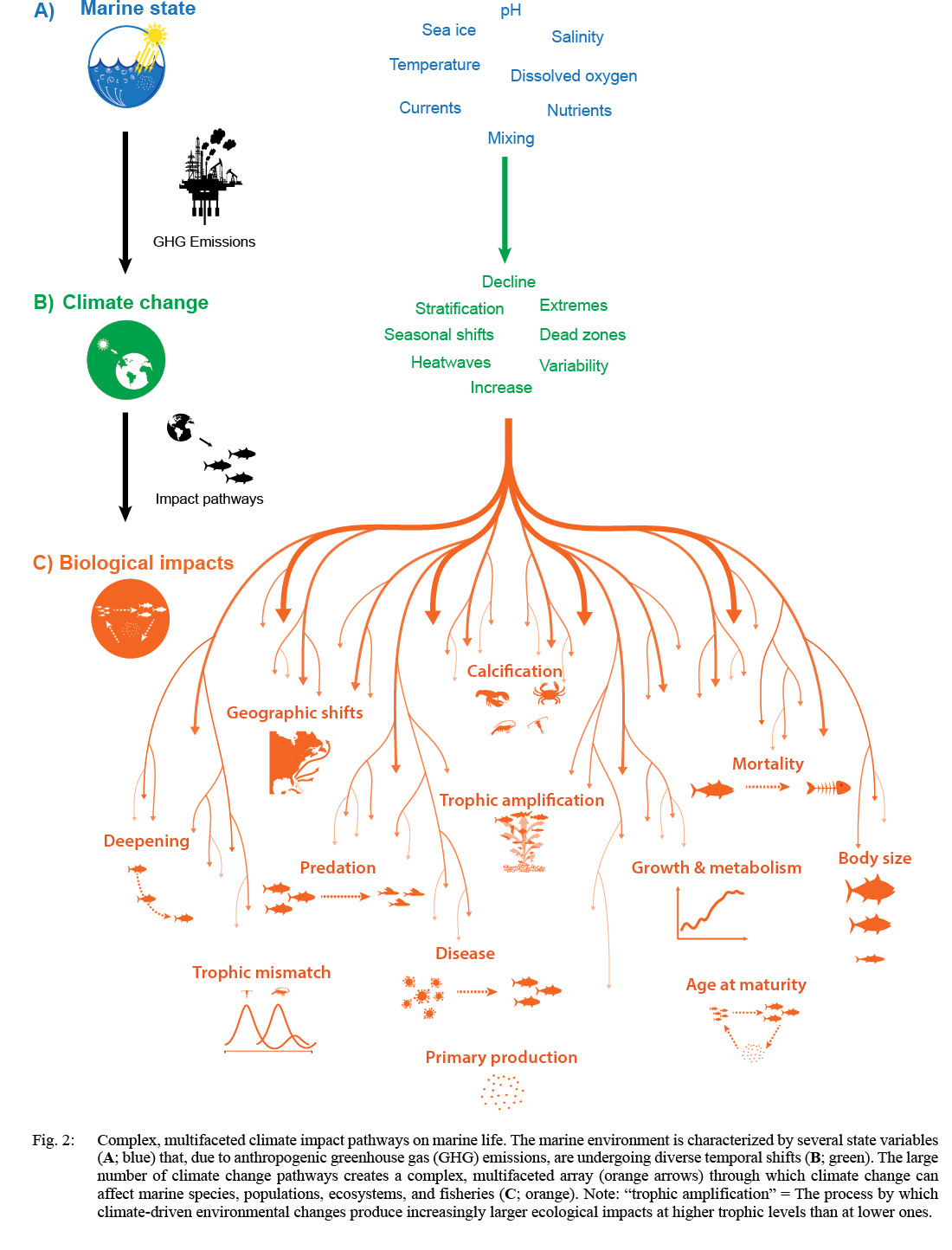
Fig. 2
Boyce et al., (2020b) reported that marine animal biomass is projected to decline across most of the southern NW Atlantic (<~60°N), with increases in the Arctic under high emissions (Fig. 5.2 in Boyce et al., 2020b). These projections broadly agree with reports that under high emissions, marine animal biomass will decline from 1971 to 2099 by an average of 7.7% within the entire Canadian EEZ, but with substantial spatial variability (±29.5%); (Bryndum-Buchholz et al., 2020).
Across the NW Atlantic, waters that supported the highest fishery landings during 2000–2018 were projected to lose the greatest marine animal biomass due to climate change, regardless of the emission scenario (Fig. 5.5 in Boyce et al., 2020b). This suggests that ongoing climate change will disrupt fisheries across the NW Atlantic and that fisheries will either need to track the spatial redistribution of fish biomass or experience reduced catch. Either way, a significant disruption to the fishing industry is likely, particularly under high-emissions scenarios. This report further noted that areas projected to experience the largest climate-driven losses in marine animal biomass are subjected to many additional stressors, such as pollution, fishing pressure, shipping traffic, and acidification, indicating that there may well be unanticipated synergies between the impacts of climate change on fisheries and the effects of other human activities.
Climate-driven species redistributions (Nye et al., 2009; Pinsky et al., 2013; MacKenzie et al., 2014) are projected to continue (Morley et al., 2018; Allyn et al., 2020). Under high emissions, 23% of transboundary fish stocks—those that move across the exclusive economic zones of two or more countries—are expected to shift by 2030, with 45% shifting by 2100 (Palacios‐Abrantes et al., 2022). Such projected shifts in species distributions are particularly apparent across the northwest Atlantic. Shackell et al., (2014) predicted changes in the thermal habitat of 46 marine species in the Northwest Atlantic (~35°N to ~48°N), reporting that by 2060, most species (55%) would lose thermal habitat, with 21% gaining and 24% remaining constant; in the US, 65% of species lost thermal habitat, with 20% gaining and 15% remaining constant. Planktivores such as herring, sand lance, and capelin were predicted to lose significant habitat in Canada and the US; this is troubling, as these forage species are critically important keystone species in many marine food webs and support a range of valuable higher-trophic-level fisheries.
Biodiversity patterns, too, are projected to shift under climate change. Reygondeau et al., (2020) projected shifts in the geographic distribution of 56 biogeochemical provinces (i.e. “Longhurst provinces”)—coherent biogeochemical environments that shape the distribution and abundance of marine biodiversity—between 1950 and 2100 under high and low emission scenarios. The study reported poleward shifts in the distribution of biogeographic provinces by an average of 18.4 km per decade and the emergence of novel biogeochemical provinces by 2040, which will encompass 1.2% of the global ocean by 2100.
Climate impacts on 14 NAFO species:
A semi-quantitative risk evaluation
Approach and data
A literature review of 175 peer-reviewed articles and 12 stock assessments was combined with quantitative analyses of species’ projected climate exposure from the Climate Risk Index for Biodiversity (CRIB) framework (Boyce et al., 2022) to arrive at a semi-quantitative climate risk score for the 14 NAFO species (low, medium, high). CRIB climate exposure indices included the species’ projected time of climate emergence (yr) and thermal habitat loss (%). The projected timing of climate emergence denotes the anticipated onset of thermal stress for a species. It is calculated as the year in which the projected temperature is projected to exceed the species’ thermal niche. Projected thermal habitat loss quantifies the magnitude of anticipated climate impacts on a species and the potential for climate-driven shifts in its geographic range. It was calculated as the proportion of a species’ present geographic range over which the projected climate will exceed its thermal niche.
These metrics were calculated for each NAFO species using its geographic distribution predicted by species distribution models (SDMs), thermal niches compiled from a literature review (Table S1), and ocean temperature projections from Earth System Models.
Native geographic distributions for NAFO species were obtained from AquaMaps (Kesner-Reyes et al., 2016). AquaMaps predicts marine species’ spatial distribution using environmental niche models validated using independent survey observations (Ready et al., 2010) and evaluated against alternative methodologies and independent datasets (Jones et al., 2012). The native geographic distributions on their 0.5° global grid were statistically rescaled to a 0.25° grid using nearest-neighbour interpolation, as described by Boyce et al., (2024).
Climate models were used to project the climate exposure of NAFO species. For pelagic NAFO species, including capelin (Mallotus villosus) and shortfin squid (Illex illecebrosus), projected sea surface temperatures were used. Projected bottom temperatures were used for demersal species. Monthly sea-surface (SST) and bottom temperature (°C) projections (2015–2100) were obtained from two published Global Earth System Climate Models in the Coupled Model Intercomparison Project Phase 6 (CMIP6) archive to evaluate projected temperature trends across the Northwest Atlantic through 2050. Projections were harmonized onto a regular 0.25° grid across the NW Atlantic under high (SSP5–8.5) and low (SSP1–2.6) emission scenarios (Meinshausen et al.,, 2020). While there is ongoing debate about the most likely emission scenario, we evaluated SSP5–8.5 and SSP1–2.6 as the extremes of the most plausible scenarios. Surface and bottom temperature changes were calculated as the difference between the average temperature in the current decade (2014–2024) and 2050 (2045–2055) within each 0.25°grid cell across the NAFO Convention Area. Changes were calculated for each model projection before averaging.
Surface waters are projected to warm across nearly the entire NAFO Convention Area, particularly under high-emissions scenarios and along continental shelves (Fig. 3A). The average surface warming across both emission scenarios in the NW Atlantic was 1°C, with some regions experiencing larger magnitude warming under high emissions (2.5°C) and others slightly cooling under low emissions (-0.8°C). Most of the bottom-water warming occurs within the 500 m isobath, with slight cooling in some deeper offshore waters (Fig. 3B). The average bottom warming across both emission scenarios in the NW Atlantic was 0.45°C, with some regions warming by up to 2.1°C under high emissions or cooling by up to -0.37°C under low emissions. Contrary to expectation, some parts of the Grand Banks experience more significant warming on the seafloor than at its surface.
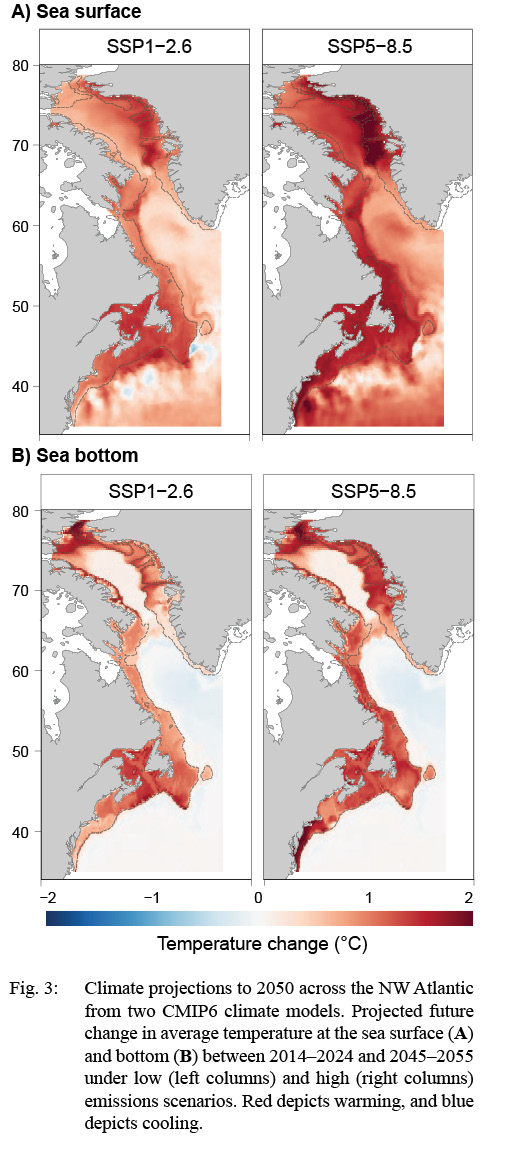
Fig. 3
Climate risk
Together, this analysis and literature review (Table 2) provided a semi-quantitative basis for evaluating climate risk (low, moderate, or high) for each species across the NW Atlantic (Figs. 4 and 5) and also helped to pinpoint where additional information may be required. Boyce et al., (2022) present the peer-reviewed rationale for defining climate risk in relation to thermal habitat loss and climate emergence (Table S4). In short, species were assessed at high risk if a majority (>~50%) of the available studies showed harmful climate impacts, and/or the projected thermal habitat loss to 2050 was over 10%, and/or the average year of climate emergence was early (2060–2090) and highly geographically variable (SD>20 years). Species were at moderate risk if some (~10–50%) of the available studies showed adverse climate impacts, and/or the projected thermal habitat loss to 2050 was ~5–10%, and/or the average year of climate emergence was later (2090s) and moderately geographically variable (SD 15–20 years). Species were at low risk if few (<~10%) or none of the available studies showed adverse climate impacts, and/or the projected thermal habitat loss to 2050 was <5%, and/or the average year of climate emergence was late (2090s) with low geographical variance (SD<15 years).
Half of the fourteen species were assessed to be at high climate risk across the NW Atlantic, including Atlantic wolffish (Anarhichas lupus), Capelin (Mallotus villosus), Northern shrimp (Pandalus borealis), Roughhead grenadier (Macrourus berglax), Splendid alfonsino (Beryx splendens), Witch flounder (Glyptocephalus cynoglossus), and Yellowtail flounder (Myzopsetta ferruginea). These species tended to have narrower thermal niches (Table S1), to experience greater projected thermal-habitat losses by 2050, and to experience thermal stress earlier across their geographic ranges. Many high-risk species are already experiencing thermal stress and habitat loss; the roughhead grenadier, splendid alfonsino, and northern shrimp have lost approximately 20% of their thermally suitable habitat, primarily around their southern range limits (Fig. 4). High-risk species experience climate impacts through several pathways, including, for instance, phenology effects and trophic mismatch on early life stages affecting recruitment (e.g., shrimp and capelin) (Koeller et al., 2009; Murphy et al., 2021), altered migration routes (e.g., halibut and capelin) (Rose, 2005; Olafsdottir and Rose, 2012; Carscaddenet al., 2013; Ferchaud et al., 2022), and changing sea ice conditions (e.g., capelin); (Buren et al., 2019). Climate effects on growth, recruitment, mortality, geographic distribution, and trophic interactions were among the most commonly reported impact pathways for these species. Few climate impact studies were available for the roughhead grenadier, splendid alfonsino, and witch flounder, making their assessment status less certain.
Four of the 14 species were assessed at moderate climate risk, including Atlantic cod (Gadus morhua), Greenland halibut (Reinhardtius hippoglossoides), redfish (Sebastes spp.), and thorny skate (Amblyraja radiata). These species tended to have broader thermal niches (Table S1) but were also experiencing thermal stress across portions of their geographic ranges, though more modest and primarily restricted to the southernmost extent of the NW Atlantic or to the Gulf of St. Lawrence (Fig. 5). In the US, areas where warming has exceeded the thorny skate thermal limit have already led to declines the warming effects are already underway (Kulkaet al., 2024).
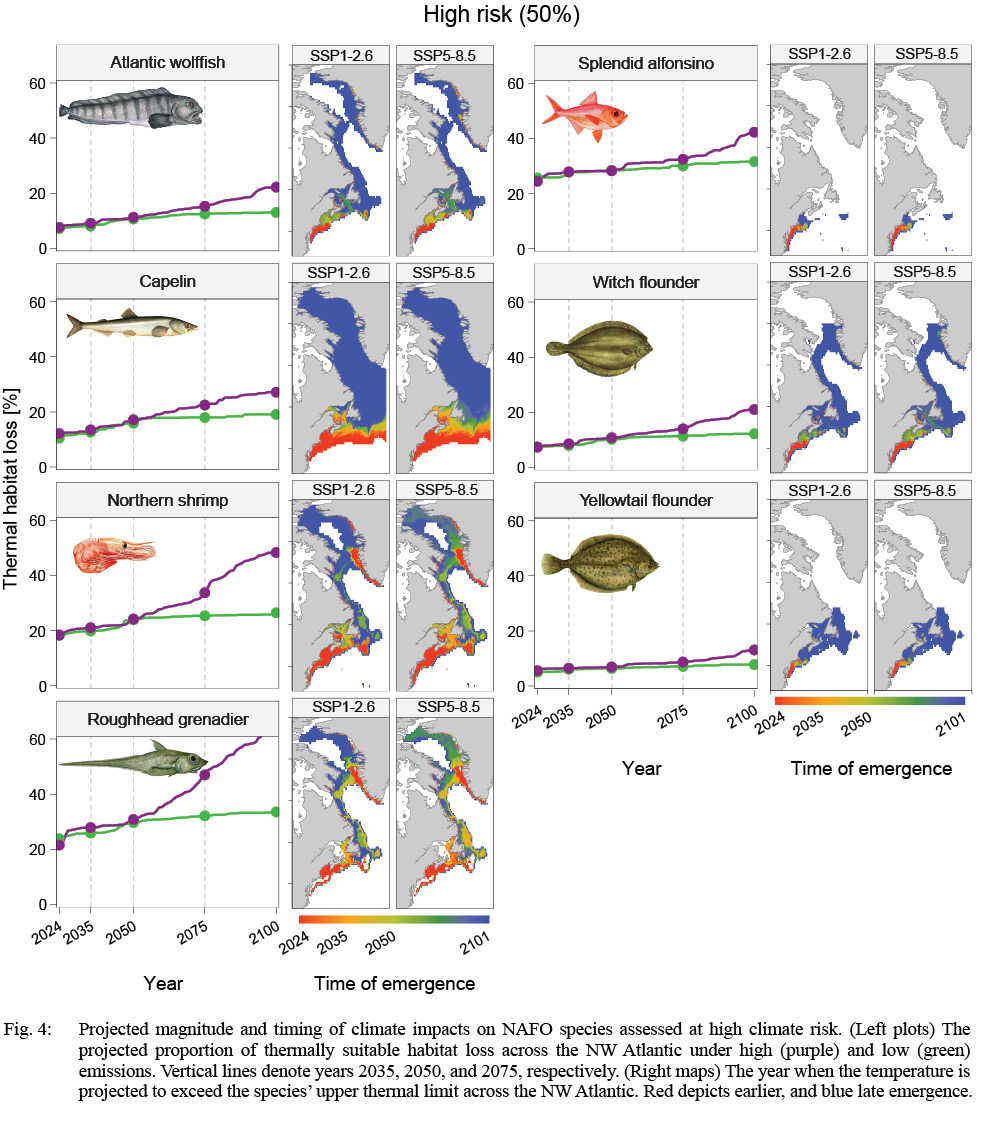
Fig. 4
Cod is among the most studied species, but fewer climate impact studies are available for redfish and thorny skate (Table 2). Most studies of cod and Greenland halibut have suggested adverse effects of climate change and significant responses to climate variability.
Three species were assessed at low climate risk. American plaice (Hippoglossoides platessoides), White hake (Urophycis tenuis), and Shortfin squid (Illex illecebrosus) tended to have broader thermal limits (Table S1), leading to later emergence times, reduced thermal habitat loss (Fig. 5), and lower climate risk. For white hake, additional climate pathways could also be important; climate-driven variability in the Labrador Current has been shown to affect larval dispersal, with consequences for settlement, recruitment, and resulting adult productivity (Han and Kulka, 2008). However, these assessments are highly uncertain, as there are very few studies on the effects of climate on these species (Table 2.)
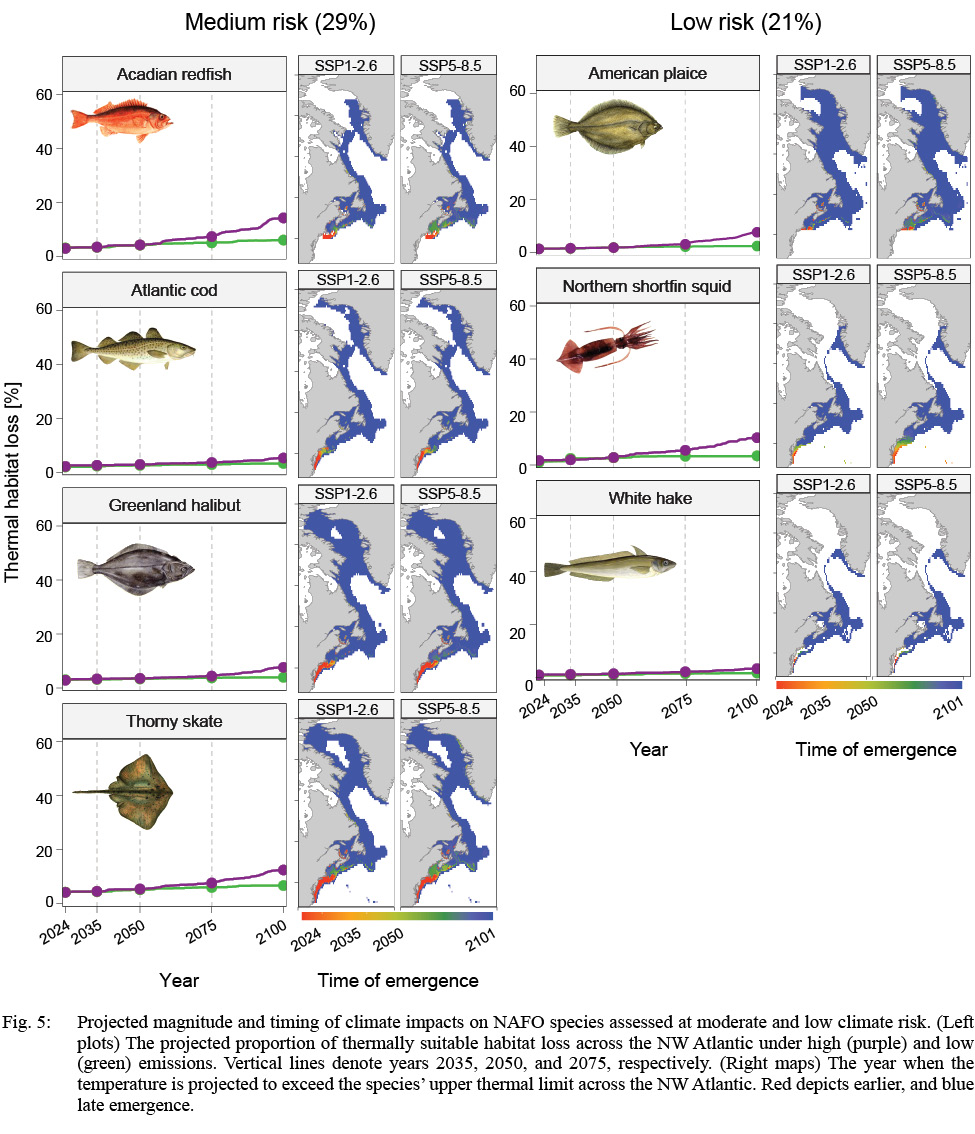
Fig. 5
Pathways to climate-informed NAFO fisheries
This section explores how to support climate resilience within NAFO fisheries, identifying three crucial elements to strengthen the integration of climate information into NAFO’s ecosystem approach to fisheries: tracking and projecting climate change, accessing integrated climate data products, and conducting climate-informed stock assessments.
Tracking and projecting climate change and its impacts
Disentangling anthropogenic climate change from natural climate variability is a challenging task that requires close ecosystem monitoring, including environmental changes, shifts in species distributions, phenology, and the emergence of pathogens and diseases. Regular environmental and ecological monitoring and dissemination, using standardized techniques, are thus key to properly tracking ongoing changes in an ecosystem. Government agencies are usually better resourced to perform these tasks and ensure continuity. In Atlantic Canada, DFO coordinates the Atlantic Zone Monitoring Program (AZMP) (Therriault et al., 1998), which annually surveys and collects multidisciplinary oceanographic data that contribute to periodic state of the Atlantic Ocean reports (Bernier et al., 2023) that summarize climate and ecosystem trends (see also the next section on integrated data products). In the U.S. Atlantic, NOAA provide annual State of the Ecosystem reports (NOAA, 2025). Long-term environmental and ecological datasets are instrumental in providing baseline information, and their continuity should be prioritized (Rosi et al., 2022).
While species are generally expected to shift into more northern and deeper waters (Nye et al., 2011; Shackell et al., 2012; Pinsky et al., 2013; Walsh et al., 2015; Morley et al., 2018), unexpected shifts have also been observed (Pinsky et al., 2013), highlighting the species-specific nature of climate responses and the need for ongoing monitoring. Geographic range shifts pose several challenges for fisheries assessment and management, including transboundary disputes, increased effort and costs for fishers to track fish, new or increased bycatch species, and potential biases in stock assessments. For instance, many NAFO assessments rely on surveys that are often fixed in time and space; this fixed design can miss shifting species distributions, leading to biased abundance estimates that underlie fishing quotas.
Several avenues exist for monitoring shifting species distributions. Standardized ecological surveys are the gold standard for tracking species distributional shifts (Nye et al., 2009, 2011; Cheung et al., 2013b; Pinsky et al., 2013; Shackell et al., 2014; Morley et al., 2018; Allyn et al., 2020; Mills et al., 2024), yet logistical challenges could arise in implementing them to track species shifts across the vast and remote NAFO Convention Area (Fig. 1). Alternatively, species distribution models (SDMs) offer a flexible and proactive approach (Kaschner et al., 2019; Karp et al., 2025; Reygondeau et al., 2025). SDMs predict the relative probability of species occurrence and habitat suitability as functions of the environment. Most SDMs are temporally static, ignoring temporal variation, and leverage historical relationships between species occurrences and environmental conditions to predict species presence.
To be useful for fisheries, SDMs must instead be dynamic, accounting for spatial and temporal variation in species occurrence and their environments. Dynamic SDMs are often more reliable and allow species distribution shifts to be tracked at a higher temporal frequency (El-Gabbas et al., 2021). A rarely met requirement of such SDMs, however, is spatially and temporally matched species occurrences and environmental variables, and high-performance computing resources, which can limit routine operational use (Karp et al., 2025).
Notwithstanding these challenges, dynamic SDMs could be developed for NAFO species using observations of species occurrence, for instance, from existing surveys, geolocated catch records, or animal tracking, and coincident temperature and other environmental observations, either sampled directly or inferred from independent data sources such as remote sensing or integrated data products. This process could be simplified using freely available statistical software packages (Dobson et al., 2023). Ideally, and in light of NAFO’s roadmap towards an ecosystem approach to fisheries (Koen-Alonso et al., 2019), such models could eventually be developed as joint-dynamics SDMs that incorporate the correlated distributions of multiple species over time (Thorson et al., 2016).
With such models, remote sensing observations could be used to estimate species distributions in real time, or to forecast climate conditions and predict where species will be months or years ahead (Tommasi et al., 2017; Mills et al., 2017). Notwithstanding the logistical and regulatory challenges, this information could be valuable for understanding where survey or fishing efforts should be deployed, anticipating shifts in stocks across management boundaries, and proactively addressing transboundary conflicts. Such tools offer a promising avenue for managing fisheries under climate change, yet they must be approached with sufficient outreach and engagement with NAFO Parties, fishing rights holders and stakeholders.
Diseases are rarely studied or considered in marine fisheries outside aquaculture, yet climate change is projected to expand bacteria’s geographic and seasonal ranges (Burge et al., 2014). Given the potentially severe consequences for fisheries productivity, monitoring for changes in disease transmission is vital to managing fisheries under climate change. While monitoring the fisheries’ catch for signs of disease is one avenue, environmental DNA (eDNA) is another new data stream that would be useful for monitoring species occurrence, including invasive species and shifts in harmful bacteria and viruses (Stat et al., 2017; Farrell et al., 2021; Rishan et al., 2023). eDNA helps monitor disease and pathogen prevalence in aquaculture (Peters et al., 2018; Shea et al., 2020) and could be a relatively low-cost means of monitoring invasive species and disease outbreaks in the Northwest Atlantic.
Seasonal shifts in fish distribution can substantially affect population productivity and fisheries, particularly by influencing recruitment and the success of early life stages (Platt et al., 2003; Edwards et al., 2004; Koeller et al., 2009; Walsh et al., 2015; Niemi et al., 2019). Furthermore, seasonal shifts in the timing of species movements and key events can bias stock biomass estimates derived from surveys conducted at fixed times and locations. Developing indicators of seasonal environmental shifts, such as the timing and magnitude of the spring phytoplankton bloom, would help monitor climate-driven changes in phenology and their impacts on NAFO stocks. For instance, Brickman and Shackell (2024) developed a series of phenology indicators and explored their application for predicting ecological responses, for instance, in the timing of inshore lobster migration, spawning times for cod, egg development times for shrimp, thermal stress in herring, and habitat condition for halibut and snow crab. Such indicators can be incredibly valuable for evaluating climate-fisheries interactions and can be derived from daily or weekly remote sensing observations of chlorophyll concentrations or surface temperatures.
A notable yet vital information gap in understanding the impacts of climate change on fisheries’ living resources is the lack of information on effects on early life stages, which are critical to fisheries productivity and sustainability. Early life stages (e.g., juveniles, larvae) often have narrower environmental tolerances than adults, rendering them more sensitive to climate variability and change (Dahlke et al., 2020). At the same time, they are often less well-monitored or studied than adults. Due to the general movement to deeper waters that occurs with increasing size or age in demersal fishes, i.e. Heincke’s law (Heincke, 1913), understanding climate impacts on fish populations involves evaluating climate changes and their effects on bottom-dwelling adults, as well as individuals occupying the pelagic zone (Frank et al., 2018). Despite these challenges, early-life-stage individuals could serve as sentinels of climate change, and monitoring them could provide early warnings of impending effects on adult biomass and productivity.
Climate vulnerability and risk assessments have been a priority focus for intergovernmental organizations (IPCC 2007, 2014) and are included in the US NMFS Fisheries Climate Science Strategy (Busch et al., 2016; Hare et al., 2016; Morrison et al., 2016) and in development at Fisheries and Oceans Canada for its Atlantic fisheries (Boyce et al., 2023). Hundreds of climate vulnerability assessments have been published (de los Ríos et al., 2018). Building on these, quantitative methods, such as the CRIB, can provide standardized, spatially explicit climate vulnerability and risk estimates for species in a flexible manner that could be useful to marine conservation and management (Lewis et al., 2023), including fisheries (Boyce et al., 2023, 2024). The CRIB assesses the likelihood of adverse consequences (IPCC, 2021) at individual locations within species’ native geographic distributions to inform conservation and management efforts where they operate. Of particular relevance to NAFO’s goal of an ecosystem approach to fisheries (Koen-Alonso et al., 2019), the CRIB evaluates climate risk at both the species and ecosystem levels (Boyce et al., 2022). Synoptic, spatially explicit climate vulnerability or risk estimates could support evidence-based decision-making under climate change, helping decision-makers to identify priorities for scientific and management efforts to implement proactive management measures, reduce impacts, increase resilience, and advance the adaptive capacity of fisheries.
Access to integrated climate data products.
The Marine Environmental Data Section (MEDS) of Fisheries and Oceans Canada provides environmental data to the NAFO Standing Committee on Fisheries Environment (STACFEN). These data primarily consist of temperature and salinity profiles collected by ships, underwater gliders, drifting buoys and floats, animal tags, and other platforms (Alcinov, 2023), which can be challenging to use. The observations are collected differently—some from standardized surveys, others opportunistically—and differ in measurement biases, sampling intensities and frequencies, and completeness. Significant effort is often required to prepare these data for use in fisheries assessments, thereby hindering their use. Integrating environmental data layers or time series would enable researchers to incorporate a more robust representation of climate variability and change into fisheries assessment and advice. The International Council for the Exploration of the Sea (ICES) Report on Ocean Climate (IROC) provides such time series on a public portal (https://ocean.ices.dk/core/iroc) together with their interpretation in a large report published every three years (González-Pola, 2023).
In Atlantic Canada, the Newfoundland and Labrador Climate Index (NLCI) combines ten climate subindices into an annually updated time-series (1951–2025) representing the climate state of the Newfoundland and Labrador shelf (Cyr and Galbraith, 2021). Additional climate products exist (Belanger et al., 2025) or are in development, including the Canadian Atlantic Bottom Temperature and Salinity (CABOTS) database that integrates in situ observations to provide seasonal values across the northwest Atlantic and eastern Arctic shelf regions from 1980 to 2023 (Coyne and Cyr, 2024). Providing similarly integrated spatiotemporal data layers for key climate variables (e.g., pH, dissolved oxygen, sea ice, primary production, and vertical mixing), as well as indicators of spatial and phenological shifts, climate projections, and forecasts (see below), would aid the integration of climate considerations into fisheries management. Some of these products are compiled and made available by STACFEN to NAFO scientists (Coyne, 2025).
Remote sensing measurements of the surface oceans enable spatially resolved evaluations of SST, wind, sea ice, chlorophyll, and other fields at high sampling frequencies (daily or monthly) in near-real time, with most data available since the 1970s. For instance, Copernicus, the Earth observation component of the European Union’s Space program, merges observations from multiple sensors to provide daily measurements of the sea surface globally. Remote sensing observations are widely used in climate impact studies but remain underutilized for fisheries assessment and management in the Northwest Atlantic. Remote sensing observations would be a valuable resource for synoptic, real-time environmental monitoring, assessing species’ geographic range shifts, and detecting seasonal shifts and trophic mismatches.
Climate projections and forecasts are increasingly used in fisheries assessment and management (A’Mar et al., 2009; Hobday et al., 2010; Bell et al., 2020). The difference between climate projections and forecasts is subtle yet important. Whereas projections explore a range of plausible climate futures that may come to pass, forecasts evaluate the most likely climate future given present-day conditions; as a result, projections tend to be multi-decadal, whereas forecasts are often seasonal (Sillmann et al., 2017). Despite the use of climate forecasts in fisheries in the US, Australia, and elsewhere, they are not yet used within NAFO. Several climate and/or Earth system models exist for the Northwest Atlantic (Lavoie et al., 2016; Saba et al., 2016; Wang et al., 2018b; Laurent et al., 2021), yet few are available at high spatial and temporal resolution across a plausible range of emission scenarios. Developing or supporting the creation of a high-resolution regional climate model for the Northwest Atlantic Ocean would be highly valuable for anticipating the impacts of climate change on NAFO living resources. Ideally, the model would forecast, rather than project, climate changes at a high resolution (~1–10 km2) across the NAFO convention area five to ten years ahead. Such a model would have numerous potential uses; it could be coupled to stock assessment operating models within a management strategy evaluation (MSE) to help determine harvest quotas under climate change; and combined within a dynamic species distribution model (see below) to predict likely geographic range shifts (El-Gabbas et al., 2021); input into a seasonal model to anticipate potential phenological shifts and trophic mismatches; or used in climate risk assessments for species (Boyce et al., 2022) and/or fisheries (Boyce et al., 2023, 2024) to understand climate impacts on fisheries living resources.
The successful development of climate-considered fisheries will depend on understanding the complex pathways by which climate impacts operate. Consolidating the available scientific literature on climate change and its impacts on NAFO species, including their environmental niches, into a centralized database would facilitate a more robust understanding of which climate impact pathways are most important for stocks, how they operate, and how to mitigate them. Such a database could also help identify information gaps that require further investigation. This report and the literature summarized in Tables S1–8 are a start, but should be enhanced and updated as new information becomes available.
Climate-informed stock assessments
Climate impacts can be directly incorporated into fisheries assessment models (Table S8), thereby enabling their explicit consideration when providing scientific advice on quota. Management strategy evaluation is a flexible modelling approach for establishing management procedures that are robust to a range of uncertainties associated with data limitations, species, ecosystem, model architecture, climate impacts, or other factors (Goethel et al., 2019).
To achieve climate and ecosystem objectives in a precautionary manner, MSE can be implemented using multispecies models that incorporate species interactions and the effects of climate variability and change on them (Sainsbury et al., 2000; Smith et al., 2007; Dichmont et al., 2008; Plagányi et al., 2013; Goethel et al., 2019; Merino et al., 2019). Similarly, uncertainties related to past (Wang et al., 2018a) or future (A’Mar et al., 2009) climate change can be evaluated within MSE using observed or forecast climate time series under different emission scenarios (Merino et al., 2019). For example, A’mar et al., (2009) incorporated climate change factors dynamically into an MSE for walleye pollock (Gadus chalcogrammus)in the Gulf of Alaska. This approach enables the quantification of key climate-change impacts when estimating population dynamics and optimizing subsequent management strategies. MSE studies have shown that the stock-recruitment relationship for Pacific sardine (Sardinops sagax) varies with SST. Based on this, the average SST over the most recent three years establishes the sardine quota for the next year (PFMC, 2007).
Duplisea et al., (2020) introduced a risk-based approach to incorporating climate change considerations into fisheries management in Canada through what the authors refer to as “climate change conditioning of science advice” (CCSA). CCSA requires information on how environmental factors affect the productivity dynamics of a resource and accounts for climate change when estimating the probability that a management objective will be met. The CCSA approach is based on risk equivalency, the concept of making management decisions of equal risk despite differences in, for instance, data availability, resource dynamics, knowledge, assessment methods, and advisory contexts. Risk-equivalency approaches have been applied in the management of Australian fisheries and in the US (Fulton et al., 2016). Like MSE, CCCA evaluates climate change in terms of risk, but it is less widely used and less flexible.
Two-thirds (66%) of NAFO-managed stocks lack assessment models. In these situations, approaches for incorporating climate variability and change into the assessment and decision-making process are less well defined (Table S8). Understanding the nature and magnitude of climate impacts on a fishery, and when and where they will arise, is fundamental to setting quotas that ensure long-term sustainability. Synthesizing the available climate-impact literature on managed species and their environmental niche limits (Table S1 and Table S7) would provide a vital baseline for understanding species’ responses to observed and anticipated environmental changes. Species often respond nonlinearly to the environment, and understanding species’ environmental limits and optimal values would be valuable for resolving variable responses to environmental variability and change and for adjusting management decisions accordingly. Including climate risk assessments, as previously described, as a standard component of the NAFO ecosystem, along with multispecies and stock assessments, would allow for contextualized advice based on climate impacts. The California sardine, Peruvian anchovy, and Bering Sea snow crab fisheries described in the following paragraph provide real-world examples of how fisheries harvest control rules can be adjusted in response to changing climate conditions.
Interdecadal-to-multidecadal climate variability significantly affects fisheries across the NW Atlantic. Developing indices to represent this climate variability, such as the North Atlantic Oscillation (NAO), the NLCI, or the Atlantic Multidecadal Oscillation (AMO), may help understand and incorporate the effects of a changing climate on stock productivity. This could involve adjusting the fishing quota in near real time based on the magnitude, duration, or phase of these indices and their expected impacts on stocks. This approach is used in other fisheries subjected to similar decadal-to-multidecadal climate variability, such as the Pacific Decadal Oscillation (PDO) and El Niño Southern Oscillation (ENSO). For instance, due to the devastating effects of El Niño-ENSO-associated warming on anchovy populations in the Humboldt Current, Peru closes its fishery during El Niño events to limit additional fishing mortality (Oliveros-Ramos et al., 2021). Marine species in the eastern Bering Sea experience alternating regime shifts driven by the PDO (Hare and Mantua 2000), and reference points for the snow crab (Chionoecetes opilio) fishery are estimated only after a climate shift has occurred (Szuwalski and Punt, 2013). Likewise, because California sardines (Sardinops sagax) are more productive when ocean temperatures are near 17.5°C (Jacobson and Maccall, 1995), ocean temperature has been incorporated into the harvest rule for sardines such that a larger fraction of the available stock is allowed to be harvested in warmer rather than colder years, though never more than 15% or less than 5% (Pinsky and Mantua, 2014). Adopting a similar approach in the Northwest Atlantic would require a working understanding of the effects of the NAO—or any comparable index—on specific stocks, real-time monitoring of the index, and agreed-upon guidelines for adjusting quotas based on its phases.
In addition to climate-informed stock assessment, integrative approaches such as the Resist–Accept–Direct (RAD) framework and forward-looking approaches such as scenario planning are complementary and can help fisheries management explicitly address climate-driven change and uncertainty (Lynch et al., 2021; Schuurman et al., 2022). Scenario planning explores a set of plausible future environmental and ecological conditions. In contrast, RAD provides a structured approach to determining whether management should resist change, accept unavoidable impacts, or actively direct systems toward more desirable future states. Together, they enhance climate consideration and resilience by making assumptions about change explicit and by supporting proactive, flexible decision-making under non-stationarity. These approaches could complement traditional stock assessments by informing reference points, harvest strategies, and spatial management with a forward-looking climate context, rather than relying solely on historical conditions.
A climate roadmap
Mapping climate
To successfully establish climate-informed NAFO fisheries, climate considerations must be integrated and harmonized within NAFO management frameworks, cycles, and governance structures, namely the NAFO Roadmap (Fig. 6A). The Roadmap is designed to guide the transition to an Ecosystem Approach to Fisheries, ensuring long-term ecosystem sustainability by incorporating ecological, social, and economic perspectives into fisheries management (Koen-Alonso et al., 2019). It emphasizes the long-term health and stability of the ecosystem and is objective-driven, requiring clear management goals to achieve it. The Roadmap’s key components include identifying ecosystem-based management units for tailored approaches, a hierarchical structure, setting exploitation rates at ecosystem, multispecies, and stock levels, ensuring sustainability across these scales, and considering the effects on non-target species and benthic communities. The Roadmap also seeks to assess adverse impacts on vulnerable marine ecosystems and of bycatch. The NAFO governance structure includes a Scientific Council (SC), which provides scientific advice, and a Commission (COM), which makes management decisions. The Roadmap progresses through stages, with the SC providing science support to COM by conducting ecosystem state assessments (Tier 1), multispecies assessments (Tier 2), and fisheries stock assessments (Tier 3). The following examines how the recommendations outlined above are integrated into the Roadmap and highlights potential avenues for improvement.
Climate state assessments
The analyses and development of methods to support the NAFO Roadmap are generally performed within the Scientific Council Working Group on Ecosystem Science and Assessment (WG-ESA), which reports back to SC. For example, WG-ESA has worked towards Ecosystem Production Potential (EPP) models and derived metrics such as Fisheries Production Potential (FPP) and Total Catch Indices (TCI); (see Koen-Alonso 2022 for a chronology of documents contributing to this work). The current NAFO Roadmap considers the broad-scale impacts of climate variability and change on ecosystem production within Tier 1—ecosystem assessments. For example, Tier 1 assesses the impacts of large-scale climate forcing on primary production and the limits this places on ecosystem carrying capacity—the assumption being that as climate-driven primary production declines, so too does cumulative ecosystem production (Koen-Alonso et al., 2019). SC also has, as part of its core structure, a Standing Committee on Fisheries Environment (STACFEN) that compiles, assesses, and reports on environmental data (Cyr and Belanger, 2025) that can be used to inform this aspect of the Roadmap. A previous review of NAFO’s Roadmap endorsed proposed approaches for the implementation of Tier 1 assessments as ‘sensible, reasonable, and even advisable’ (NAFO, 2022).
Here, we propose adding an overarching Tier 0 Climate State to the Roadmap. Such an addition would not alter any functionality of the Roadmap but could help incorporate important climate change and impact pathways highlighted in this report that are not currently considered in Tier 1. Where Tier 1 considers climate-driven impacts on cumulative ecosystem production, Tier 0 could provide the type of detailed foundational climate data needed to resolve climate impacts on, for instance, stock size structure, geographic distribution, or seasonal development, as well as impacts operating on populations or stocks (e.g., Tier 3) rather than entire ecosystems. In short, Tier 0 could support the current Roadmap while furthering a more explicit integration of climate variability and change into ecosystem and fishery assessment and management processes at Tiers 1–3 (Fig. 6B).
Such an assessment would incorporate previous suggestions related to climate data products, including developing integrated data products of key oceanographic variables (e.g., surface and bottom temperatures, dissolved oxygen, chlorophyll) to evaluate climate trends, evaluating indices of changing phenology, assessing the onset and magnitude of climate variability (e.g., climate indices), and forecasting or projecting how climate conditions will evolve. While the report would describe the past, current and future climate state across the NW Atlantic, a vital contribution would be the generation of integrated, quality-checked, and ready-to-use climate data products that could be deployed in other SC Roadmap assessments (Tiers1–3).
The International Council for the Exploration of the Sea (ICES) produces an annual report on ocean climate conditions across the North Atlantic (González-Pola et al., 2023), NOAA provide annual State of the Ecosystem reports for the Northeast U.S. Shelf (NOAA, 2025), and DFO produces periodic reports on the state of the Atlantic Canadian Ocean (Galbraith et al., 2025), providing examples of how such an assessment could be developed within the NAFO Roadmap. The ICES reports on ocean climate (IROCs) combine historical ocean observations to describe ocean conditions, trends, and variability across the North Atlantic Ocean and summarize and distribute climate data through an interactive, easy-to-use, publicly available web platform. While the IROCs focus on historical data and trends, a NAFO analogue ideally would include forecasted or projected trends.
Climate impacts on NAFO ecosystems and stocks
Within the ecosystem assessment (Tier 1), climate data from the climate state assessment (Tier 0) could be used to evaluate important climate impact pathways on ecosystems in addition to the currently considered impacts on bulk primary production and overall system carrying capacity. Studies suggest that ocean biogeochemical provinces that shape biodiversity and constrain ecosystem structure and fisheries productivity will shift under ongoing climate change (Reygondeau et al., 2020), meaning that the ecosystem production units used in the Roadmap should also be monitored to detect climate-driven shifts in productivity and adjust fisheries quotas accordingly. Geographic patterns of ecosystem climate risk can be assessed and monitored using approaches such as the CRIB, which also allows for evaluating future climate scenarios and their ecological impacts (Boyce et al., 2022, 2024). Catch limits for the ecosystem unit could be adjusted depending on climate-informed impact thresholds, as employed in other fisheries (Szuwalski and Punt, 2013; Pinsky and Mantua, 2014; Oliveros-Ramos et al., 2021). Climate-driven shifts in disease and pathogens could also be monitored and assessed, for instance, using eDNA, as part of the ecosystem assessment (Baillie et al., 2019; Abbott et al., 2021).
Within the Roadmap, multispecies assessments (Tier 2) are a means of understanding species interactions and trends, the role of anthropogenic and environmental drivers on ecosystem structure and dynamics, and defining multispecies reference points (Koen-Alonso et al., 2019). Climate data from the climate state assessment provides a means to explore climate variability and change in multispecies dynamics and to adjust reference points accordingly. Dynamic joint SDMs could be used to examine climate-driven shifts in species distribution in real time (Thorson et al., 2016), while climate risk assessment could evaluate spatial patterns in climate risks at the species level to mitigate them (Boyce et al., 2022). The impacts of shifting environmental phenology on species interactions (trophic mismatch) (Cushing 1990, 1995) could likewise be explored at this level. Fisheries and ecosystem models are becoming increasingly detailed and reliable, and could be explored to resolve the effects of projected or forecasted climate changes on the biomass of exploited species and ecological interactions (Tittensor et al., 2018b, 2018a, 2021).
In the Roadmap, single species assessments (Tier 3) form the basis for stock-specific catch levels, and where quota decisions should also be informed by Tiers 1–2. Stock assessments represent the most detailed examination of trends and drivers in fish populations, and several recommendations discussed previously fall under their purview, including evaluating past and anticipated distribution shifts (e.g., dynamic SDMs), phenology, trophic mismatch and its effects on recruitment, climate impacts on early life stages, climate risk analyses at the level of individual stocks, and developing climate-integrated assessment models. Evaluating climate impacts on each stock as a standard assessment practice would be a meaningful way to support climate-informed assessment and advice, particularly for the 66% of NAFO stocks that lack assessment models. Such an impact assessment would interpret population dynamics in the context of climate trends reported in the climate state assessment (Tier 0), integrate the available knowledge from the suggested climate impact database, and include a standardized climate risk assessment carried out for each stock, such as has been undertaken using the CRIB framework (Boyce et al., 2023, 2024). Such vulnerability and risk analyses have been widely promoted as a means of developing climate-informed fisheries advice and are included as a priority in the Fisheries Climate Science Strategy of the US NMFS as a tool to inform research and management activities related to understanding and adapting marine fisheries management to climate change (Busch et al., 2016).
Overarching considerations
While fisheries scientists have traditionally been solely responsible for assessing stock status and providing advice, the Roadmap’s objectives regarding the ecosystem approach to fisheries (EAF) and the integration of climate considerations within it are multidisciplinary, requiring expertise from climate scientists, oceanographers, ecologists, and social scientists. Climate considerations pervade the Roadmap; therefore, including oceanographers and climate scientists at each level (Tiers 0–3) would support its integration into the assessment and management process.
Integrating climate considerations into the Roadmap more explicitly and fully will require a robust evidence base—a strong understanding of the pathways by which climate affects species, populations, and ecosystems. A climate impacts database that synthesizes the current state of knowledge on climate change and its effects on NAFO species and stocks, and that supports regular climate risk assessment at the species and ecosystem scales, would help support this process across all Tiers. Climate vulnerability and risk assessments can supplement this knowledge, providing objective evaluations of how the likelihood of climate impacts varies across taxa and geographies, and how this information could be incorporated into fisheries management.
The current Roadmap includes ecosystem considerations, requiring an expansion of the taxonomic scale of analysis. Explicitly including climate considerations will require greater temporal resolution in the assessments. Further, climate change can interact with seasonal and basin-scale climate variability to create large, abrupt climate changes. >NAFO assessment cycles must be able to respond dynamically to abrupt, unanticipated climate changes.
Conclusions
This study suggests that the climate system across the Northwest Atlantic Ocean is dynamic, with substantial seasonal, decadal, and multidecadal variability overlaying long-term climate changes (Tables S2–3). Overall, the Northwest Atlantic Ocean is becoming warmer, more acidic, more hypoxic, more stratified, and more nutrient-depleted, with declining sea ice. These trends are expected to continue into the foreseeable future, with the magnitude of changes depending on emission trajectories.
Marine species within the NAFO Convention Area are already experiencing a range of climate impacts, which are likely to continue or intensify over the coming years (Tables S4–5). Direct effects of temperature are more frequently evaluated and described, particularly for well-studied species such as Atlantic cod. In contrast, indirect climate effects, such as altered predation, prey availability, shifting phenology, and disease transmission, are less commonly studied but are nonetheless likely to occur and be important. Indirect climate impacts can be exceedingly challenging to pinpoint, as they often co-occur with other drivers such as fishing, competition, or anthropogenic stressors. Across species, early life stages appear to be more sensitive to climate impacts consistently, and juveniles and smaller individuals commonly have narrower thermal limits than adults, highlighting the importance of considering life history in climate impact evaluations (Dahlke et al., 2020). Notwithstanding these challenges, several avenues exist for incorporating climate variability and change into fisheries management to strengthen the resilience and the productivity of fish stocks (Table S8). Understanding both the impacts of climate change on fisheries within the NAFO Convention Area and the pathways to integrate the information into science assessments and the NAFO Roadmap will better equip NAFO Parties to address climate impacts in support of healthy oceans and sustainable fisheries.
Acknowledgements
This work was part of the FAO program—Global Sustainable Fisheries Management and Biodiversity Conservation in the Areas Beyond National Jurisdiction (ABNJ); it was supported by the Common Oceans Deep-sea Fisheries under the Ecosystem Approach (DSF) project, FAO, under the GEF International Waters focal area (GEF ID 10623). This report has benefited from valuable feedback and suggestions from the NAFO Climate Change steering committee, particularly Miguel Caetano, Diana González Troncoso, Lisa Hendrickson, Mariano Koen-Alonso, and Anthony Thompson.
References
A’Mar, Z. T., Punt, A. E., and Dorn, M. W. 2009. The evaluation of two management strategies for the Gulf of Alaska walleye pollock fishery under climate change. ICES J. Mar. Sci., 66(7): 1614–1632. https://doi.org/10.1093/icesjms/fsp044.
Abbott, C., Coulson, M., Gagne, N., Lacoursiere-Roussel, A., Parent, G. J., Bajno, R., Dietrich, C., and May-McNally, S. 2021. Guidance on the Use of Targeted Environmental DNA (eDNA) Analysis for the Management of Aquatic Invasive Species and Species at Risk. Can. Sci. Advis. Secr. Res. Doc., 2021/019: 46.
Alcinov, T. 2023. NAFO STACFEN MEDS Report 2022. Northwest Atl. Fish. Organ. NAFO SCR Document: 23/019, Serial No. N4706, 34 p.
Alexander, M. A., Shin, S. I., Scott, J. D., Curchitser, E., and Stock, C. 2020. The response of the Northwest Atlantic Ocean to Climate Change. J. Clim., 33(2): 405–428. https://doi.org/10.1175/JCLI-D-19-0117.1.
Allyn, A. J., Alexander, M. A., Franklin, B.S., Massiot-Allyn, A. J., Alexander, M. A., Franklin, B. S., Massiot-Granier, F., Pershing, A. J., Scott, J. D., and Mills, K. E. 2020. Comparing and synthesizing quantitative distribution models and qualitative vulnerability assessments to project marine species distributions under climate change. PLoS One, 15(4): e0231595. https://doi.org/10.1371/journal.pone.0231595.
Altieri, A. H., Harrison, S. B., Seemann, J., Collin, R., Diaz, R. J., and Knowlton, N. 2017. Tropical dead zones and mass mortalities on coral reefs. Proc. Natl. Acad. Sci. U.S.A., 114(14): 3660–3665. https://doi.org/10.1073/pnas.1621517114.
Asch, R. G. 2015. Climate change and decadal shifts in the phenology of larval fishes in the California Current ecosystem. Proc. Natl. Acad. Sci. U.S.A., 201421946. https://doi.org/10.1073/pnas.1421946112.
Azam, F., and Malfatti, F. 2007. Microbial structuring of marine ecosystems. Nat. Rev. Microbiol. 5(10): 782–791. https://doi.org/10.1038/nrmicro1747.
Baillie, S. M., McGowan, C., May-McNally, S., Leggatt, R., Sutherland, B. J. G., and Robinson, S. 2019. Environmental DNA and its applications to Fisheries and Oceans Canada: National needs and priorities. Can. Tech. Rep. Fish. Aquat. Sci., 3329: xiv+84 p.
Barange, M., Cheung, W. W. L., Merino, G., and Perry, R. I. 2010. Modelling the potential impacts of climate change and human activities on the sustainability of marine resources. Curr. Opin. Environ. Sustain., 2(5–6): 326–333. https://doi.org/10.1016/j.cosust.2010.10.002.
Barneche, D. R., White, C. R., and Marshall, D. J. 2018. Fish reproductive-energy ouput increases disproportionately with body size. Science, (80-. ). 645(May): 642–645. https://doi.org/10.1126/science.aao6868.
Barton, A. D., Irwin, A. J., Finkel, Z. V., and Stock, C. A. 2016. Anthropogenic climate change drives shift and shuffle in North Atlantic phytoplankton communities. Proc. Natl. Acad. Sci., 113(11): 2964–2969. https://doi.org/10.1073/pnas.1519080113.
Baum, J. K., Myers, R. A., Kehler, D. G., Worm, B., Harley, S. J., and Doherty, P. A. 2003. Collapse and Conservation of Shark Populations in the Northwest Atlantic. Science. (80-. . 299(5605): 389–92. https://doi.org/10.1126/science.1079777.
Behrenfeld, M. J., O’Malley, R. T., Siegel, D. A, McClain, C. R., Sarmiento, J. L., Feldman, G. C., Milligan, A. J., Falkowski, P. G., Letelier, R. M., and Boss, E. S. 2006. Climate-driven trends in contemporary ocean productivity. Nature, 444(7120): 752–755. https://doi.org/10.1038/nature05317.
Belanger, D., Coyne, J., and Cyr, F. 2025. Environmental indices for NAFO subareas 0 to 4 in support of the Standing Committee on Fisheries Science (STACFIS) – 2024 update. NAFO SCR Doc. 25/012 Serial No. N7639 18 p.
Bell, R. J., Odell, J., Kirchner, G., and Lomonico, S. 2020. Actions to Promote and Achieve Climate-Ready Fisheries: Summary of Current Practice. Mar. Coast. Fish., 12(3): 166–190. https://doi.org/10.1002/mcf2.10112.
Bernier, R. Y., Jamieson, R. E., Moore, A. M., Kelly, N. E., Lafleur, C., and Moore, A. M. 2023. State of the Atlantic Ocean synthesis report. Can. Tech. Rep. Fish. Aquat. Sci., 3544, v+219 p
Bond, N. A., Cronin, M. F., Freeland, H., and Mantua, N. 2015. Causes and impacts of the 2014 warm anomaly in the NE Pacific. Geophys. Res. Lett., 42(9): 3414–3420. https://doi.org/10.1002/2015GL063306.
Borggaard, D. L., Dick, D. M., Star, J., Zoodsma, B., Alexander, M. A., Asaro, M. J., Barre, L., Bettridge, S., Burns, P., Crocker, J., Dortch, Q., Garrison, L., Gulland, F., Haskell, B., Hayes, S., Kenry, A., Kyde, K., Milliken, H., Quinlan, J., Rowles, T., Saba, V., Staudinger, M., and Walsh, H. 2020. North Atlantic Right Whale (Eubalaena glacialis) Scenario Planning Summary Report. NOAA Tech. Memo, NMFS-OPR-6: 88 p.
Boyce, D. G., Dowd, M., Lewis, M. R., and Worm, B. 2014. Estimating global chlorophyll changes over the past century. Prog. Oceanogr., 122(January): 163–173. Elsevier Ltd. https://doi.org/10.1016/j.pocean.2014.01.004.
Boyce, D. G., Frank, K. T., and Leggett, W. C. 2015a. From mice to elephants: overturning the ‘one size fits all’ paradigm in marine plankton food chains. Ecol. Lett., 18: 504–515. https://doi.org/10.1111/ele.12434.
Boyce, D. G., Frank, K. T., Worm, B., and Leggett, W. C. 2015b. Spatial patterns and predictors of trophic control across marine ecosystems. Ecol. Lett., 18(10): 1001–1011. https://doi.org/10.1111/ele.12481.
Boyce, D. G., Fuller, S., Karbowski, C., Schleit, K., and Worm, B. 2021. Leading or lagging: How well are climate change considerations being incorporated into Canadian fisheries management? Can. J. Fish. Aquat. Sci., 78(8): 1120–1129. https://doi.org/10.1139/cjfas-2020-0394.
Boyce, D. G., Lewis, M. L., and Worm, B. 2010. Global phytoplankton decline over the past century. Nature, 466(7306): 591–596. Nature Publishing Group. https://doi.org/10.1038/nature09268.
Boyce, D. G., Lotze, H. K., Tittensor, D. P., Carozza, D. A., and Worm, B. 2020a. Future ocean biomass losses may widen socioeconomic equity gaps. Nat. Commun. 11(2235): 1–11. https://doi.org/10.1038/s41467-020-15708-9.
Boyce, D. G., Schleit, K., and Fuller, S. 2020b. Incorporating climate change into fisheries management in Atlantic Canada and the Eastern Arctic. Ocean. North Rep., 184 p. Available from www.oceansnorth.org.
Boyce, D. G., Shackell, N., Greyson, P., and Greenan, B. 2023. A prospective framework to support climate-adaptive fisheries in Canada. FACETS, 8: 1–15. https://doi.org/10.1139/facets-2022-0164.
Boyce, D. G., Tittensor, D. P., Fuller, S., Henson, S., Kaschner, K., Reygondeau, G., Schleit, K. E., Saba, V., Shackell, N., Stanley, R. R. E., and Worm, B. 2024. Operationalizing climate risk in a global warming hotspot. npj Ocean Sustain., 3(1): 33. Springer US. https://doi.org/10.1038/s44183-024-00067-5.
Boyce, D. G., Tittensor, D. P., Garilao, C., Henson, S., Kaschner, K., Kesner-Reyes, K., Pigot, A., Reyes, R. B., Reygondeau, G., Schleit, K. E., Shackell, N.L., Sorongon-Yap, P., and Worm, B. 2022. A climate risk index for marine life. Nat. Clim. Chang., 12(9): 854–862. https://doi.org/10.1038/s41558-022-01437-y.
Boyce, D. G., and Worm, B. 2015. Patterns and ecological implications of historical marine phytoplankton change. Mar. Ecol. Prog. Ser., 534: 251–272. https://doi.org/10.3354/meps11411.
Brander, K. M. 2005. Cod recruitment is strongly affected by climate when stock biomass is low. ICES Journal of Marine Science, 62: 339–343. https://doi.org/10.1016/j.icesjms.2004.07.029.
Brander, K. 2010. Impacts of climate change on fisheries. J. Mar. Syst., 79: 389–402. https://doi.org/10.1016/j.jmarsys.2008.12.015
Brander, K. M. 2007. Global fish production and climate change. Proc. Natl. Acad. Sci. U.S.A., 104(50): 19709–19714. https://doi.org/10.1073/pnas.0702059104.
Breitburg, D., Levin, L. A., Oschlies, A., Gregoire, M., Chavez, F. P., Conley, D. J., Garcon, V., Gilbert, D., Gutierrez, D., Isensee, K., Jacinto, G. S., Limburg, K. E., Montes, I., Naqvi, S. W. A., Pitcher, G. C., Rabalais, N. N., Roman, M. R., Rose, K. A., Seibel, B. A., Telszewski, M., Yasuhara, M., and Zhang, J. 2018. Declining oxygen in the global ocean and coastal waters. Science, (80-. ). 359(6371): 46+. https://doi.org/10.1126/science.aam7240.
Brickman, D., and Shackell, N. L. 2024. Phenology metrics for ocean waters with application to future climate change in the Northwest Atlantic Ocean. Elem. Sci. Anth., 12(1). https://doi.org/10.1126/science.aam7240.
Bryndum-Buchholz, A., Prentice, F., Tittensor, D. P., Blanchard, J. L., Cheung, W. W. L., Christensen, V., Galbraith, E. D., Maury, O., and Lotze, H. K. 2020. Differing marine animal biomass shifts under 21st century climate change between Canada’s three oceans. Facets, 5(1): 105–122. https://doi.org/10.1139/facets-2019-0035.
Bryndum-Buchholz, A., Tittensor, D. P., Blanchard, J. L., Cheung, W. W. L., Coll, M., Galbraith, E. D., Jennings, S., Maury, O., and Lotze, H. K. 2018. Twenty-first-century climate change impacts on marine animal biomass and ecosystem structure across ocean basins. Glob. Chang. Biol., 25(2): 459–472. https://doi.org/10.1111/gcb.14512.
Buren, A. D., Murphy, H. M., Adamack, A. T., Davoren, G. K., Koen-Alonso, M., Montevecchi, W. A., Mowbray, F. K., Pepin, P., Regular, P. M., Robert, D., Rose, G. A., Stenson, G. B., and Varkey, D. 2019. The collapse and continued low productivity of a keystone forage fish species. Mar. Ecol. Prog. Ser., 616: 155–170. https://doi.org/10.3354/meps12924.
Burge, C. A., Eakin, C. M., Friedman, C. S., Froelich, B., Hershberger, P. K., Hofmann, E. E., Petes, L. E., Prager, K. C., Weil, E., Willis, B. L., Ford, S. E., and Harvell, C. D. 2014. Climate Change Influences on Marine Infectious Diseases: Implications for Management and Society. In (Eds.) S. Carlson, CA and Giovannoni. Annual Review of Marine Science, pp. 249–277. https://doi.org/10.1146/annurev-marine-010213-135029.
Busch, D. S., Griffis, R., Link, J., Abrams, K., Baker, J., Brainard, R. E., Ford, M., Hare, J.A., Himes-Cornell, A., Hollowed, A., Mantua, N. J., McClatchie, S., McClure, M., Nelson, M.W ., Osgood, K., Peterson, J. O., Rust, M., Saba, V., Sigler, M. F., Sykora-Bodie, S., Toole, C., Thunberg, E., Waples, R. S., and Merrick, R. 2016. Climate science strategy of the US National Marine Fisheries Service. Mar. Policy, 74: 58–67. https://doi.org/10.1016/j.marpol.2016.09.001.
Caputi, N., Kangas, M., Denham, A., Feng, M., Pearce, A., Hetzel, Y., and Chandrapavan, A. 2016. Management adaptation of invertebrate fisheries to an extreme marine heat wave event at a global warming hot spot. Ecol. Evol., 6(11): 3583–3593. https://doi.org/10.1002/ece3.2137.
Carscadden, J. E., Gjosaeter, H., and Vilhjalmsson, H. 2013. A comparison of recent changes in distribution of capelin (Mallotus villosus) in the Barents Sea, around Iceland and in the Northwest Atlantic. Prog. Oceanogr., 114(SI): 64–83. https://doi.org/10.1016/j.pocean.2013.05.005.
Cavicchioli, R., Ripple, W. J., Timmis, K. N., Azam, F., Bakken, L. R., Baylis, M., Behrenfeld, M. J., Boetius, A., Boyd, P. W., Classen, A. T., Crowther, T. W., Danovaro, R., Foreman, C. M., Huisman, J., Hutchins, D. A., Jansson, J. K., Karl, D. M., Koskella, B., Mark Welch, D. B., Martiny, J. B. H., Moran, M. A., Orphan, V. J., Reay, D. S., Remais, J. V., Rich, V. I., Singh, B. K., Stein, L. Y., Stewart, F. J., Sullivan, M. B., van Oppen, M. J. H., Weaver, S. C., Webb, E. A., and Webster, N. S. 2019. Scientists’ warning to humanity: microorganisms and climate change. Nat. Rev. Microbiol.: 569–586 https://doi.org/10.1038/s41579-019-0222-5.
Cavole, L.-C. M., Demko, A. M., Diner, R. E., Giddings, A., Koester, I., Pagniello, C. M. L. S., Paulsen, M.-L., Ramirez-Valdez, A., Schwenck, S. M., Yen, N. K., Zill, M. E., and Franks, P. J. S. 2016. Biological Impacts of the 2013–2015 Warm-Water Anomaly in the Northeast Pacific. Oceanography, 29(2, SI): 273–285. https://doi.org/10.5670/oceanog.2016.322.
Cermeno, P., Dutkiewicz, S., Harris, R. P., Follows, M., Schofield, O., and Falkowski, P. 2008. The role of nutricline depth in regulating the ocean carbon cycle. Proc. Natl. Acad. Sci. U. S. A., 105(51): 20344–20349. https://doi.org/10.1073/pnas.0811302106.
Chen, K., Gawarkiewicz, G. G., Lentz, S. J., and Bane, J. M. 2014. Diagnosing the warming of the Northeastern US Coastal Ocean in 2012: A linkage between the atmospheric jet stream variability and ocean response. J. Geophys. Res. Oceans, 119(1): 218–227. https://doi.org/10.1002/2013JC009393.
Cheung, W., Lam, V., and Pauly, D. 2016a. Modelling present and climate-shifted distribution of marine fishes and invertebrates. Fish. Cent. Res. Reports, 72 p.
Cheung, W. W. L., Jones, M. C., Reygondeau, G., Stock, C. A., Lam, V. W. Y., and Frölicher, T. L. 2016b. Structural uncertainty in projecting global fisheries catches under climate change. Ecol. Modell., 325: 57–66. Elsevier B.V. https://doi.org/10.1016/j.ecolmodel.2015.12.018.
Cheung, W. W. L., Sarmiento, J. L., Dunne, J., Frölicher, T. L., Lam, V. W. Y., Deng Palomares, M. L., Watson, R., Pauly, D., Froelicher, T. L., Lam, V. W. Y., Palomares, M. L. D., Watson, R., and Pauly, D. 2013a. Shrinking of fishes exacerbates impacts of global ocean changes on marine ecosystems. Nat. Clim. Chang., 3(3): 254–258. Nature Publishing Group, https://doi.org/10.1038/nclimate1691.
Cheung, W. W. L., Pinnegar, J., Merino, G., Jones, M. C., and Barange, M. 2012. Review of climate change impacts on marine fisheries in the UK and Ireland. Aquat. Conserv. Freshw. Ecosyst., 22(3): 368–388. https://doi.org/10.1002/aqc.2248.
Cheung, W. W. L., Watson, R., and Pauly, D. 2013b. Signature of ocean warming in global fisheries catch. Nature, 497(7449): 365–368. Nature Publishing Group, https://doi.org/10.1038/nature12156.
Cheung, W. W. L., Lam, V. W. Y., Sarmiento, J. L., Kearney, K., Watson, R., Zeller, D., and Pauly, D. 2010. Large-scale redistribution of maximum fisheries catch potential in the global ocean under climate change. Glob. Chang. Biol. 16(1): 24–35. https://doi.org/10.1111/j.1365-2486.2009.01995.x.
Coyne, J., and Cyr, F. 2024. Canadian Atlantic Bottom Observations of Temperature and Salinity (CABOTS).
Cushing, D. 1995. Population production and regulation in the sea: a fisheries perspective. Edited By Cambridge.
Cushing, D. H. 1969. The Regularity of the Spawning Season of Some Fishes. J. Cons. Int. Explor. Mer., 33: 81–92. https://doi.org/10.1093/icesjms/33.1.81.
Cushing, D. H. 1990. Plankton Production and Year-class Strength in Fish Populations: an Update of the Match Mismatch Hypothesis. Adv. Mar. Biol., 26: 249–293. https://doi.org/10.1016/S0065-2881(08)60202-3.
Cyr, F., and Belanger, D. 2024. Environmental indices for NAFO subareas 0 to 4 in support of the Standing Committee on Fisheries Science (STACFIS) – 2023 update. NAFO SCR Doc. 24/012, Serial No. N7515, 21 p.
Cyr, F., and Galbraith, P. S. 2021. A climate index for the Newfoundland and Labrador shelf. Earth Syst. Sci. Data, 13(5): 1807–1828. https://doi.org/10.5194/essd-13-1807-2021.
Cyr, F., Galbraith, P. S., Layton, C., Hebert, D., Chen, N., and Han, G. 2022. Environmental and Physical Oceanographic Conditions on the Eastern Canadian shelves (NAFO Sub-areas 2, 3 and 4) during 2021. NAFO SCR Doc. 22/020, Serial No. N7293: 64 p.
Cyr, F., Lewis, K., Bélanger, D., Regular, P., Clay, S., and Devred, E. 2024. Physical controls and ecological implications of the timing of the spring phytoplankton bloom on the Newfoundland and Labrador shelf. Limnol. Oceanogr. Lett., 9(3): 191–198. https://doi.org/10.1002/lol2.10347.
Cyr, F., Adamack, A. T., Bélanger, D., Koen-Alonso, M., Mullowney, D., Murphy, H., Regular, P., and Pepin, P. 2025. Environmental control on the productivity of a heavily fished ecosystem. Nat. Commun., 16(1): 5277. https://doi.org/10.1038/s41467-025-60453-6.
Dahlke, F. T., Wohlrab, S., Butzin, M., and Portner, H.-O. 2020. Thermal bottlenecks in the life cycle define climate vulnerability of fish. Science (80-. ). 369(6499): 65–70. https://doi.org/10.1126/science.aaz3658.
Dai, Y., Yang, S., Zhao, D., Hu, C., Xu, W., Anderson, D. M., Li, Y., Song, X.-P., Boyce, D. G., Gibson, L., Zheng, C., and Feng, L. 2023. Coastal phytoplankton blooms expand and intensify in the 21st century. Nature, 615(7951): 280–284. https://doi.org/10.1126/science.1156401.
de los Ríos, C., Watson, J. E. M., and Butt, N. 2018. Persistence of methodological, taxonomical, and geographical bias in assessments of species’ vulnerability to climate change: A review. Glob. Ecol. Conserv., 15. https://doi.org/10.1016/j.gecco.2018.e00412.
Delworth, T. L., Zeng, F., Vecchi, G. A., Yang, X., Zhang, L., and Zhang, R. 2016. The North Atlantic Oscillation as a driver of rapid climate change in the Northern Hemisphere. Nat. Geosci., 9(7): 509+. https://doi.org/10.1038/ngeo2738.
DFO. 2022. Canada’s Oceans Now: Atlantic Ecosystems. 2022.
DFO. 2025. NAFO Subdivision 3Ps Atlantic cod (Gadus morhua) stock assessment in 2024. DFO Can. Sci. Advis. Secr. Advis. Rep., 2025/07, 12 p.
Diaz, R.J.R.J., and Rosenberg, R. 2008. Spreading dead zones and consequences for marine ecosystems. Science (80-. ). 321(5891): 926–9. https://doi.org/10.1126/science.1156401.
Dichmont, C. M., Deng, A., Punt, A. E., Ellis, N., Venables, W. N., Kompas, T., Ye, Y., Zhou, S., and Bishop, J. 2008. Beyond biological performance measures in management strategy evaluation: Bringing in economics and the effects of trawling on the benthos. Fish. Res., 94(3, SI): 238–250. https://doi.org/10.1016/j.fishres.2008.05.007.
Dobson, R., Challinor, A. J., Cheke, R. A., Jennings, S., Willis, S. G., and Dallimer, M. 2023. dynamicSDM: An R package for species geographical distribution and abundance modelling at high spatiotemporal resolution. Methods Ecol. Evol., 14(5): 1190–1199. https://doi.org/10.1111/2041-210X.14101.
Drinkwater, K. F. 2005. The response of Atlantic cod (Gadus morhua) to future climate change. ICES J. Mar. Sci., 62(7): 1327–1337. https://doi.org/10.1016/j.icesjms.2005.05.015.
Dulvy, N. K., Rogers, S. I., Jennings, S., Stelzenmuller, V., Dye, S. R., and Skjoldal, H. R. 2008. Climate change and deepening of the North Sea fish assemblage: A biotic indicator of warming seas. J. Appl. Ecol., 45: 1029–1039. https://doi.org/10.1111/j.1365-2664.2008.01488.x.
Duplisea, D. E., Roux, M.-J., Hunter, K. L., and Rice, J. 2020. Resource management under climate change: a risk-based strategy to develop climate-informed science advice. DFO Can. Sci. Advis. Sec. Res. Doc. 2019/044, v+45 p.
du Pontavice, H., Chen, Z., and Saba, V. S. 2023. A high-resolution ocean bottom temperature product for the northeast U.S. continental shelf marine ecosystem. Prog. Oceanogr., 210(July 2022): 102948. Elsevier Ltd. https://doi.org/10.1016/j.pocean.2022.102948.
Edwards, M., Richardson, A. J., and Martin Edwards & Anthony J. Richardson. 2004. Impact of climate change on marine pelagic phenology and trophic mismatch. Nature, 430(7002): 881–884. https://doi.org/10.1038/nature02808.
El-Gabbas, A., Van Opzeeland, I., Burkhardt, E., and Boebel, O. 2021. Dynamic Species Distribution Models in the Marine Realm: Predicting Year-Round Habitat Suitability of Baleen Whales in the Southern Ocean. Front. Mar. Sci., 8. https://doi.org/10.3389/fmars.2021.802276.
Fabry, V. J., Seibel, B. A., Feely, R. A., and Orr, J. C. 2008. Impacts of ocean acidification on marine fauna and ecosystem processes. ICES J. Mar. Sci., 65(3): 414–432. https://doi.org/10.1093/icesjms/fsn048.
FAO. 2018. Impacts of climate change on fisheries and aquaculture: synthesis of current knowledge, adaptation and mitigation options. In (Eds.) M. Barange, T. Bahiri, M. C. M. Beveridge, K. L. Cochrane, S. Funge-Smith, and F. Poulain. FAO Fisheries and Aquaculture Technical Paper, Rome. 628 p.
Farrell, J. A., Whitmore, L., and Duffy, D. J. 2021. The Promise and Pitfalls of Environmental DNA and RNA Approaches for the Monitoring of Human and Animal Pathogens from Aquatic Sources. Bioscience, 71(6): 609–625. https://doi.org/10.1093/biosci/biab027.
Ferchaud, A.L., Normandeau, E., Babin, C., Præbel, K., Hedeholm, R., Audet, C., Morgan, J., Treble, M., Walkusz, W., Sirois, P., and Bernatchez, L. 2022. A cold-water fish striving in a warming ocean: Insights from whole-genome sequencing of the Greenland halibut in the Northwest Atlantic. Front. Mar. Sci., 9(September): 1–18. https://doi.org/10.3389/fmars.2022.992504.
Frank, K. T., Petrie, B., Leggett, W. C., and Boyce, D. G. 2018. Exploitation drives an ontogenetic-like deepening in marine fish. Proc. Natl. Acad. Sci., 115(25): 6–11. https://doi.org/10.1073/pnas.1802096115.
Frank, K. T., Petrie, B., Leggett, W. C., and Boyce, D. G. 2019. Fishing matters: Age-specific deepening is driven by exploitation. Proc. Natl. Acad. Sci. U.S.A., https://doi.org/10.1073/pnas.1819288116.
Frank, K. T., Petrie, B., and Shackell, N. L. 2007. The ups and downs of trophic control in continental shelf ecosystems. Trends Ecol. Evol., 22(5): 236–242. https://doi.org/10.1016/j.tree.2007.03.002.
Frank, K. T., Petrie, B., Shackell, N. L., and Choi, J. S. 2006. Reconciling differences in trophic control in mid-latitude marine ecosystems. Ecol. Lett., 9(10): 1096–1105. https://doi.org/10.1111/j.1461-0248.2006.00961.x.
Fredston, A. L., Cheung, W. W. L., Frölicher, T. L., Kitchel, Z. J., Maureaud, A. A., Thorson, J. T., Auber, A., Mérigot, B., Palacios-Abrantes, J., Palomares, M. L. D., Pecuchet, L., Shackell, N. L., and Pinsky, M. L. 2023. Marine heatwaves are not a dominant driver of change in demersal fishes. Nature, 621(7978): 324–329. https://doi.org/10.1038/s41586-023-06449-y.
Free, C. M., Thorson, J. T., Pinsky, M. L., Oken, K. L., Wiedenmann, J., and Jensen, O. P. 2019. Impacts of historical warming on marine fisheries production. Science, (80-. ). 363(6430): 979–983. https://doi.org/10.1126/science.aau1758.
Frommel, A. Y., Maneja, R., Lowe, D., Malzahn, A. M., Geffen, A. J., Folkvord, A., Piatkowski, U., Reusch, T. B. H. H., and Clemmesen, C. 2012. Severe tissue damage in Atlantic cod larvae under increasing ocean acidification. Nat. Clim. Chang., 2(1): 42–46. Nature Publishing Group. https://doi.org/10.1038/nclimate1324.
Fulton, E., Punt, A., Dichmont, C., Gorton, R., Sporcic, M., Dowling, N., Little, L., Haddon, M., Klaer, N., and Smith, D. 2016. Developing risk equivalent data-rich and data-limited harvest strategies. Fish. Res., 183: 574–587. https://doi.org/10.1016/j.fishres.2016.07.004.
Gaines, S. D., Costello, C., Owashi, B., Mangin, T., Bone, J., Molinos, J. G., Burden, M., Dennis, H., Halpern, B. S., Kappel, C. V., Kleisner, K. M., and Ovando, D. 2018. Improved fisheries management could offset many negative effects of climate change. Sci. Adv., 4(8): 1–9. https://doi.org/10.1126/sciadv.aao1378.
Galbraith, P. S., Lizotte, M., Blais, M., Belanger, D., Casault, B., Coyne, J., Layton, C., Azetsu-Scott, K., Beazley, L., Chasse, J., Clay, S., Cyr, F., Devred, E., Fudge, A., Gabriel, C. E., Greenen, B., Hebert, A. J., Johnson, L., Maillet, G., Penney, J., Rastin, S., Ringuette, M., Shaw, J. L., Snook, S., and Starr, M. 2025. Oceanographic conditions in the Atlantic zone in 2024. Can. Tech. Rep. Hydrogr. Ocean Sci., 400: viii+49 p. https://doi.org/10.60825/e92v-d229.
Garcia, S. M., and Grainger, R. 1997. Fisheries management and sustainability: A new perspective of an old problem? In (Eds.) by D.A. Hancok, D.C. Smith, A. Grant, and J. Beumer. CSIRO Publishing, Melbourne. Developing and sustaining world fisheries resources. The state of science and management. pp. 175–236.
Gattuso, J.-P., Magnan, A., Billé, R., Cheung, W. W. L., Howes, E. L., Joos, F., Allemand, D., Bopp, L., Cooley, S. R., Eakin, C. M., Hoegh-Guldberg, O., Kelly, R. P., Pörtner, H. O., Rogers, A. D., Baxter, J. M., Laffoley, D., Osborn, D., Rankovic, A., Rochette, J., Sumaila, U. R., Treyer, S., Turley, C., Bille, R., Cheung, W. W. L., Howes, E. L., Joos, F., Allemand, D., Bopp, L., Cooley, S. R., Eakin, C. M., Hoegh-Guldberg, O., Kelly, R. P., Portner, H.-O., Rogers, A. D., Baxter, J. M., Laffoley, D., Osborn, D., Rankovic, A., Rochette, J., Sumaila, U. R., Treyer, S., Turley, C. 2015. Contrasting futures for ocean and society from different anthropogenic CO2 emissions scenarios. Science, (80-. ). 349(6243): https://doi.org/10.1126/science.aac4722.
Gibb, O., Cyr, F., Azetsu-Scott, K., Chassé, J., Childs, D., Gabriel, C.E., Galbraith, P. S., Maillet, G., Pepin, P., Punshon, S., and Starr, M. 2023. Spatiotemporal variability in pH and carbonate parameters on the Canadian Atlantic continental shelf between 2014 and 2022. Earth Syst. Sci. Data, 15(9): 4127–4162. https://doi.org/10.5194/essd-15-4127-2023.
Gilbert, D., Sundby, B., Gobeil, C., Mucci, A., and Tremblay, G. H. 2005. A seventy-two-year record of diminishing deep-water oxygen in the St. Lawrence estuary: The northwest Atlantic connection. Limnol. Oceanogr., 50(5): 1654–1666. https://doi.org/10.4319/lo.2005.50.5.1654.
Goethel, D. R., Lucey, S. M., Berger, A. M., Gaichas, S. K., Karp, M. A., Lynch, P. D., and Walter, J. F. 2019. Recent advances in management strategy evaluation: Introduction to the special issue “Under pressure: Addressing fisheries challenges with management strategy evaluation.” Can. J. Fish. Aquat. Sci., 76(10): 1689–1696. https://doi.org/10.1139/cjfas-2019-0084.
González-Carrión, F., and Saborido-Rey, F. 2022. Influence of maternal effects and temperature on fecundity of Sebastes fasciatus on the Flemish Cap. Scientia Marina, 86. https://doi.org/10.3989/scimar.05305.050
González-Pola, C., Larsen, K. M. H., Fratantoni, P., Beszczynska-Moeller, A., (Eds.). 2023. ICES Report on ocean climate. ICES Coop. Res. Reports, 358: 123. https://doi.org/10.17895/ices.pub.24755574.
Grady, J. M., Maitner, B. S., Winter, A. S., Kaschner, K., Tittensor, D. P., Record, S., Smith, F. A., Wilson, A. M., Dell, A. I., Zarnetske, P. L., Wearing, H. J., Alfaro, B., and Brown, J. H. 2019. Metabolic asymmetry and the global diversity of marine predators. Science, (80-. ). 363(6425): 366+. https://doi.org/10.1126/science.aat4220.
Han, G., and Kulka, D. W. 2008. Dispersion of eggs, larvae and pelagic juveniles of White Hake (Urophycis tenuis) in relation to ocean currents of the Grand Bank: A modelling approach. J. Northwest Atl. Fish. Sci. 41: 183–196. https://doi.org/10.2960/J.v41.m627.
Hare, J. A., Morrison, W. E., Nelson, M. W., Stachura, M. M., Teeters, E. J., Griffis, R. B., Alexander, M. A., Scott, J. D., Alade, L., Bell, R. J., Chute, A. S., Curti, K. L., Curtis, T. H., Kircheis, D., Kocik, J. F., Lucey, S. M., McCandless, C. T., Milke, L. M., Richardson, D. E., Robillard, E., Walsh, H. J., McManus, M. C., Marancik, K. E., and Griswold, C. A. 2016. A Vulnerability Assessment of Fish and Invertebrates to Climate Change on the Northeast u.s. Continental Shelf. PLoS One 11(2): 1–30. https://doi.org/10.1371/journal.pone.0146756.
Hare, S. R., and Mantua, N. J. 2000. Empirical evidence for North Pacific regime shifts in 1977 and 1989. Prog. Oceanogr., 47(2–4): 103–145. https://doi.org/10.1016/S0079-6611(00)00033-1.
Harvell, C. D., Montecino-Latorre, D., Caldwell, J. M., Burt, J. M., Bosley, K., Keller, A., Heron, S. F., Salomon, A. K., Lee, L., Pontier, O., Pattengill-Semmens, C., and Gaydos, J. K. 2019. Disease epidemic and a marine heat wave are associated with the continental-scale collapse of a pivotal predator (Pycnopodia helianthoides). Sci. Adv., 5(1). https://doi.org/10.1126/sciadv.aau7042.
Heincke, F. 1913. Investigations on the plaice. General report 1. Rapports et Procès-Verbaux des Réunions. Int. Counc. Explor. Sea, 17.
Hilborn, R., Amoroso, R. O., Anderson, C. M., Baum, J. K., Branch, T. A., Costello, C., De Moor, C. L., Faraj, A., Hively, D., Jensen, O. P., Kurota, H., Little, L. R., Mace, P., McClanahan, T., Melnychuk, M. C., Minto, C., Osio, G. C., Parma, A. M., Pons, M., Segurado, S., Szuwalski, C. S., Wilson, J. R., and Ye, Y. 2020. Effective fisheries management instrumental in improving fish stock status. Proc. Natl. Acad. Sci. U. S. A., 117(4): 2218–2224. https://doi.org/10.1073/pnas.1909726116.
Hinder, S. L., Hays, G. C., Edwards, M., Roberts, E. C., Walne, A.W., and Gravenor, M. B. 2012. Changes in marine dinoflagellate and diatom abundance under climate change. Nat. Clim. Chang., 2(4): 271–275. Nature Publishing Group. https://doi.org/10.1038/nclimate1388.
Hobday, A. J., Hartog, J. R., Timmiss, T., and Fielding, J. 2010. Dynamic spatial zoning to manage southern bluefin tuna (Thunnus maccoyii) capture in a multi-species longline fishery. Fish. Oceanogr., 19(3): 243–253. https://doi.org/10.1111/j.1365-2419.2010.00540.x.
Hoegh-Guldberg, O., and Bruno, J. F. 2010. The Impact of Climate Change on the World’s Marine Ecosystems. Science, (80-. ). 328(5985): 1523–1528. https://doi.org/10.1126/science.1189930.
Hollowed, A. B., Barange, M., Beamish, R. J., Brander, K., Cochrane, K., Drinkwater, K., Foreman, M. G. G., Hare, J. A., Holt, J., Ito, S. I., Kim, S., King, J. R., Loeng, H., MacKenzie, B. R., Mueter, F. J., Okey, T. A., Peck, M. A., Radchenko, V. I., Rice, J. C., Schirripa, M. J., Yatsu, A., and Yamanaka, Y. 2013. Projected impacts of climate change on marine fish and fisheries. ICES J. Mar. Sci., 70(5): 1023–1037. https://doi.org/10.1093/icesjms/fst081.
Holsman, K. K., Hazen, E. L., Haynie, A., Gourguet, S., Hollowed, A., Bograd, S. J., Samhouri, J. F., Aydin, K., and Anderson, E. 2019. Towards climate resiliency in fisheries management. ICES J. Mar. Sci., 76(5): 1368–1378. https://doi.org/10.1093/icesjms/fsz031.
Hughes, T. P., Kerry, J. T., Alvarez-Noriega, M., Alvarez-Romero, J. G., Anderson, K. D., Baird, A. H., Babcock, R. C., Beger, M., Bellwood, D. R., Berkelmans, R., Bridge, T. C., Butler, I. R., Byrne, M., Cantin, N. E., Comeau, S., Connolly, S. R., Cumming, G. S., Dalton, S. J., Diaz-Pulido, G., Eakin, C. M., Figueira, W. F., Gilmour, J. P., Harrison, H. B., Heron, S. F., Hoey, A. S., Hobbs, J.-P. A., Hoogenboom, M. O., Kennedy, E. V, Kuo, C., Lough, J. M., Lowe, R. J., Liu, G., McCulloch, M. T., Malcolm, H. A., McWilliam, M. J., Pandolfi, J. M., Pears, R. J., Pratchett, M. S., Schoepf, V., Simpson, T., Skirving, W. J., Sommer, B., Torda, G., Wachenfeld, D. R., Willis, B. L., and Wilson, S. K. 2017. Global warming and recurrent mass bleaching of corals. Nature, 543(7645): 373+. https://doi.org/10.1038/nature21707.
Hurrell, J. W., and Deser, C. 2009. North Atlantic climate variability: The role of the North Atlantic Oscillation. J. Mar. Syst., 79(3–4): 231–244. https://doi.org/10.1016/j.jmarsys.2009.11.002.
Hurrell, J. W., Visbeck, M., Busalacchi, A., Clarke, R. A., Delworth, T. L., Dickson, R. R., Johns, W. E., Koltermann, K. P., Kushnir, Y., Marshall, D., Mauritzen, C., McCartney, M. S., Piola, A., Reason, C., Reverdin, G., Schott, F., Sutton, R., Wainer, I., and Wright, D. 2006. Atlantic climate variability and predictability: A CLIVAR perspective. J. Clim., 19(20): 5100–5121. https://doi.org/10.1175/JCLI3902.1.
Hutchings, J. A., Côté, I. M., Dodson, J. J., Fleming, I. A., Jennings, S., Mantua, N.J., Peterman, R. M., Riddell, B. E., and Weaver, A. J. 2012. Climate change, fisheries, and aquaculture: trends and consequences for Canadian marine biodiversity. Environmental Reviews, 20, 220–311. https://doi.org/10.1139/a2012-011.
Hutchings, J. A., Minto, C., Ricard, D., Baum, J. K., and Jensen, O. P. 2010. Trends in the abundance of marine fishes. Can. J. Fish. Aquat. Sci., 67(8): 1205–1210. https://doi.org/10.1139/F10-081.
Hutchings, J. A., Myers, R. A., Garcia, V. B., Lucifora, L. O., and Kuparinen, A. 2012b. Life-history correlates of extinction risk and recovery potential. Ecol. Appl., 22: 1061–1067. https://doi.org/10.1890/11-1313.1.
Ina‐Salwany, M. Y., Al‐saari, N., Mohamad, A., Mursidi, F., Mohd‐Aris, A., Amal, M.N.A., Kasai, H., Mino, S., Sawabe, T., and Zamri‐Saad, M. 2019. Vibriosis in Fish: A Review on Disease Development and Prevention. J. Aquat. Anim. Health, 31(1): 3–22. https://doi.org/10.1002/aah.10045.
IPCC. 2007. Climate change 2007: synthesis report. Summary for policymakers. Fourth Assessment Report. Intergovernmental Panel on Climate Change, Gland, Switzerland.
IPCC, Field, C. B., Barros, V., Stocker, T. F., Qin, D., Dokken, D. J., Ebi, K. L., et al. 2012. Managing the Risks of Extreme Events and Disasters to Advance Climate Change Adaptation - SREX Summary for Policymakers. Cambridge University Press, Cambridge, U.K., New York, USA. 1–19 p.
IPCC. 2014. Climate Change 2014: Synthesis Report. Contribution of Working Groups I, II and III to the Fifth Assessment Report of the Intergovernmental Panel on Climate Change. R.K. Pachauri and R.A. Meyer, (Eds.). IPCC, Geneva, Switzerland.
IPCC. 2019. Chapter 5: Changing Ocean, Marine Ecosystems, and Dependent Communities. IPCC Special Report on the Ocean and Cryosphere in a Changing Climate: 447–588. Cambridge University Press. https://www.cambridge.org/core/product/identifier/9781009157964%23pre3/type/book_part.
IPCC. 2021. Climate Change 2021: The Physical Science Basis. Contribution of Working Group I to the Sixth Assessment Report of the Intergovernmental Panel on Climate Change. V. Masson-Delmotte, P. Zhai, A. Pirani, S. L. Connors, C. Pean, S. Berger, N. Caud, Y. Chen, L. Goldfarb, M. I. Gomis, M. Huang, K. Leitzell, E. Lonnoy, J. B. R. Matthews, T. K. Maycock, T. Waterfield, O. Yelekci, R. Yu, and B. Zhou (Eds.) Cambridge University Press, Cambridge, U.K. https://doi.org/10.1017/9781009157896.
IPCC, Field, C. B., Barros, V., Stocker, T. F., Qin, D., Dokken, D. J., Ebi, K. L., Mastrandrea, M. D., Mach, K. J., Plattner, G.-K., Allen, S. K., Tignor, M., and Midgley, P. M. 2012. Managing the Risks of Extreme Events and Disasters to Advance Climate Change Adaptation - SREX Summary for Policymakers. In A Special Report of Working Groups I and II of the Intergovernmental Panel on Climate Change. Cambridge University Press, Cambridge, U.K., New York, USA. https://doi.org/10.1017/CBO9781139177245.
Jacobson, L. D., and MacCall, A. D. 1995. Stock-recruitment models for Pacific sardine (Sardinops sagax). Can. J. Fish. Aquat. Sci., 52(3): 566–577. https://doi.org/10.1139/f95-057.
Jöhnk, K. D., Huisman, J., Sharples, J., Sommeijer, B., Visser, P. M., and Stroom, J. M. 2008. Summer heatwaves promote blooms of harmful cyanobacteria. Glob. Chang. Biol., 14(3): 495–512. https://doi.org/10.1111/j.1365-2486.2007.01510.x.
Jones, M. C., Dye, S. R., Pinnegar, J. K., Warren, R., and Cheung, W. W. L. 2012. Modelling commercial fish distributions: Prediction and assessment using different approaches. Ecol. Modell., 225: 133–145. Elsevier B.V. https://doi.org/10.1016/j.ecolmodel.2011.11.003.
Karp, M. A., Cimino, M., Craig, J. K., Crear, D. P., Haak, C., Hazen, E. L., Kaplan, I., Kobayashi, D. R., Moustahfid, H., Muhling, B., Pinsky, M. L., Smith, L. A., Thorson, J. T., and Woodworth-Jefcoats, P. A. 2025. Applications of species distribution modeling and future needs to support marine resource management. ICES J. Mar. Sci., 82(3). https://doi.org/10.1093/icesjms/fsaf024.
Kaschner, K., Kesner-Reyes, K., Garilao, C., Segschneider, J., Rius-Barile, J., Rees, T., and Froese, R. 2019. Aquamaps: Predicted range maps for aquatic species.
Kesner-Reyes, K., Kaschner, K., Kullander, S., Garilao, C., Barile, J., and Froese, R. 2016. AquaMaps: algorithm and data sources for aquatic organisms. In FishBase. (Eds.) R. Froese and D. Pauly. World Wide Web electronic publication. www.fishbase.org, version (04/2012). Available from www.fishbase.org.
Kirby, R. R., and Beaugrand, G. 2009. Trophic amplification of climate warming. Proc. R. Soc. B Biol. Sci., 276(1676): 4095–4103. https://doi.org/10.1098/rspb.2009.1320.
Kleisner, K. M., Fogarty, M. J., McGee, S., Hare, J. A., Moret, S., Perretti, C. T., and Saba, V. S. 2017. Marine species distribution shifts on the U.S. Northeast Continental Shelf under continued ocean warming. Prog. Oceanogr., 153: 24–36. Elsevier Ltd. https://doi.org/10.1016/j.pocean.2017.04.001.
Koeller, P. A., Fuentes-Yaco, C., and Platt, T. 2007. Decreasing shrimp (Pandalus borealis) sizes off Newfoundland and Labrador - Environment or fishing? Fisheries Oceanography, 16: 105–115. https://doi.org/10.1111/j.1365-2419.2006.00403.x.
Koeller, P., Fuentes-Yaco, C., Platt, T., Sathyendranath, S., Richards, A., Ouellet, P., Orr, D., Skúladóttir, U., Wieland, K., Savard, L., and Aschan, M. 2009. Basin-scale Coherence in Phenology of Shrimps and Phytoplankton in the North Atlantic Ocean. Science, (80-. ). 324(5928): 791–793. https://doi.org/10.1126/science.1170987.
Koen-Alonso, M. 2022. Supporting material for the independent scientific review of the estimation of fisheries production potential and total catch indices, and their adequacy for their proposed used within the NAFO Roadmap. NAFO Sci. Counc. Res. Doc. 22/003, Serial No. N7267 5 p.
Koen-Alonso, M., Pepin, P., Fogarty, M.J., Kenny, A., and Kenchington, E. 2019. The Northwest Atlantic Fisheries Organization Roadmap for the development and implementation of an Ecosystem Approach to Fisheries: structure, state of development, and challenges. Mar. Policy, 100(August): 342–352. Elsevier Ltd. https://doi.org/10.1016/j.marpol.2018.11.025.
Kulka, D. W., Miri, C. M., Atchison, S., and Simpson, M. R. 2024. An Ecomorphological Description of Amblyraja radiata (Rajiformes: Rajidae) in Waters of Eastern Canada. Diversity 16(10): 595. https://doi.org/10.3390/d16100595.
Kulka, D. W., Thompson, S., Cocliati, K., Olmstead, M., Austin, D., and Pepin, P. 2022. An Accounting of Integration of Environmental Variables in Fishery Stock Assessments in Canada. Can. Tech. Rep. Fish. Aquat. Sci. 3473: viii+79 p.
Kwiatkowski, L., Aumont, O., and Bopp, L. 2019. Consistent trophic amplification of marine biomass declines under climate change. Glob. Chang. Biol., 25(1): 218–229. https://doi.org/10.1111/gcb.14468.
Kwok, R., and Rothrock, D.A. 2009. Decline in Arctic sea ice thickness from submarine and ICESat records: 1958–2008. Geophys. Res. Lett. 36(15): L15501.
Laurent, A., Fennel, K., and Kuhn, A. 2021. An observation-based evaluation and ranking of historical Earth system model simulations in the northwest North Atlantic Ocean. Biogeosciences, 18(5): 1803–1822. https://doi.org/10.5194/bg-18-1803-2021.
Lavoie, D., Chasse, J., Simard, Y., Lambert, N., Galbraith, P. S., Roy, N., and Brickman, D. 2016. Large-Scale Atmospheric and Oceanic Control on Krill Transport into the St. Lawrence Estuary Evidenced with Three-Dimensional Numerical Modelling. Atmosphere-Ocean, 54(3, SI): 299–325. https://doi.org/10.1080/07055900.2015.1082965.
Lawler, J. J., Tear, T. H., Pyke, C., Shaw, R. M., Gonzalez, P., Kareiva, P., Hansen, L., Hannah, L., Klausmeyer, K., Aldous, A., Bienz, C., and Pearsall, S. 2010. Resource management in a changing and uncertain climate. Front. Ecol. Environ., 8(1): 35–43. https://doi.org/10.1890/070146.
Le Bris, A., Mills, K. E., Wahle, R. A., Chen, Y., Alexander, M. A., Allyn, A. J., Schuetz, J. G., Scott, J. D., and Pershing, A. J. 2018. Climate vulnerability and resilience in the most valuable North American fishery. Proc. Natl. Acad. Sci. U. S. A., 115(8): 1831–1836. https://doi.org/10.1073/pnas.1711122115.
Lewandowska, A. M., Boyce, D. G., Hofmann, M., Matthiessen, B., Sommer, U., and Worm, B. 2014. Effects of sea surface warming on marine plankton. Ecol. Lett., 17(5): 614–623. https://doi.org/10.1111/ele.12265.
Lewis, S. A., Stortini, C. H., Boyce, D. G., and Stanley, R. R. E. 2023. Climate change, species thermal emergence, and conservation design: a case study in the Canadian Northwest Atlantic. FACETS, 8: 1–16. https://doi.org/10.1139/facets-2022-0191.
Li, W. K. W., McLaughlin, F. A, Lovejoy, C., and Carmack, E. C. 2009. Smallest algae thrive as the Arctic Ocean freshens. Science, 326(5952): 539 p. https://doi.org/10.1126/science.1179798.
Loder, J. W., Han, G., Galbraith, P. S., Chassé, J., and, Baaren, A. V. D. B. (Eds.) 2013. Aspects of climate change in the Northwest Atlantic off Canada. Can. Manuscr. Rep. Fish. Aqautic Sci., 3045: 190 p.
Lotze, H. K., Tittensor, D. P., Bryndum-Buchholz, A., Eddy, T. D., Cheung, W. W. L., Galbraith, E. D., Barange, M., Barrier, N., Bianchi, D., Blanchard, J. L., Bopp, L., Büchner, M., Bulman, C. M., Carozza, D. A., Christensen, V., Coll, M., Dunne, J. P., Fulton, E. A., Jennings, S., Jones, M. C., Mackinson, S., Maury, O., Niiranen, S., Oliveros-Ramos, R., Roy, T., Fernandes, J. A., Schewe, J., Shin, Y.-J., Silva, T. A. M., Steenbeek, J., Stock, C. A., Verley, P., Volkholz, J., Walker, N. D., and Worm, B. 2019. Global ensemble projections reveal trophic amplification of ocean biomass declines with climate change. Proc. Natl. Acad. Sci., 116(26): 12907–12912. https://doi.org/10.1073/pnas.1900194116
Lynch, A. J., Thompson, L. M., Beever, E. A., Cole, D. N., Engman, A. C., Hawkins Hoffman, C., Jackson, S. T., Krabbenhoft, T. J., Lawrence, D. J., Limpinsel, D., Magill, R. T., Melvin, T. A., Morton, J. M., Newman, R. A., Peterson, J. O., Porath, M. T., Rahel, F. J., Schuurman, G. W., Sethi, S. A., and Wilkening, J. L. 2021. Managing for RADical ecosystem change: applying the Resist‐Accept‐Direct (RAD) framework. Front. Ecol. Environ., 19(8): 461–469. https://doi.org/10.1002/fee.2377.
MacKenzie, B. R., Payne, M. R., Boje, J., Høyer, J. L., and Siegstad, H. 2014. A cascade of warming impacts brings bluefin tuna to Greenland waters. Glob. Chang. Biol., 20(8): 2484–2491. https://doi.org/10.1111/gcb.12597.
Martinez, E., Antoine, D., D’Ortenzio, F., and Gentili, B. 2009. Climate-Driven Basin-Scale Decadal Oscillations of Oceanic Phytoplankton. Science, (80-. ). 326(5957): 1253–1256. https://doi.org/10.1126/science.1177012.
Meehl, G. A., and Tebaldi, C. 2004. More intense, more frequent, and longer lasting heat waves in the 21st century. Science, (80-. ). 305(5686): 994–997. https://doi.org/10.1126/science.1098704.
Meinshausen, M., Nicholls, Z. R. J., Lewis, J., Gidden, M. J., Vogel, E., Freund, M., Beyerle, U., Gessner, C., Nauels, A., Bauer, N., Canadell, J. G., Daniel, J. S., John, A., Krummel, P. B., Luderer, G., Meinshausen, N., Montzka, S. A., Rayner, P. J., Reimann, S., Smith, S. J., van den Berg, M., Velders, G. J. M., Vollmer, M. K., and Wang, R. H. J. 2020. The shared socio-economic pathway (SSP) greenhouse gas concentrations and their extensions to 2500. Geosci. Model Dev., 13(8): 3571–3605. https://doi.org/10.5194/gmd-13-3571-2020.
Melvin, A. M., Larsen, P., Boehlert, B., Neumann, J. E., Chinowski, P., Espinet, X., Martinich, J., Baumann, M.S., Rennels, L., Bothner, A., Nicolsky, D. J., and Marchenko, S. S. 2016. Climate change damages to Alaska public infrastructure and the economics of proactive adaptation. Proc. Natl. Acad. Sci. U. S. A., 114: E122–E131. https://doi.org/10.1073/pnas.1611056113.
Merino, G., Arrizabalaga, H., Arregui, I., Santiago, J., Murua, H., Urtizberea, A., Andonegi, E., De Bruyn, P., and Kell, L. T. 2019. Adaptation of North Atlantic Albacore Fishery to Climate Change: Yet Another Potential Benefit of Harvest Control Rules. Front. Mar. Sci., 6(620): 1–14. https://doi.org/10.3389/fmars.2019.00620.
Mills, K. E., Kemberling, A., Kerr, L. A., Lucey, S. M., McBride, R. S., Nye, J. A., Pershing, A. J., Barajas, M., and Lovas, C. S. 2024. Multispecies population-scale emergence of climate change signals in an ocean warming hotspot. ICES J. Mar. Sci., 81(2): 375–389. https://doi.org/10.1093/icesjms/fsad208.
Mills, K. E., Pershing, A. J., Hernandez, C. M., and Hernández, C. M. 2017. Forecasting the Seasonal Timing of Maine’s Lobster Fishery. Front. Mar. Sci., 4. https://doi.org/10.3389/fmars.2017.00337.
Morán, X. A. G., López-Urrutia, Á., Calvo-Díaz, A., and Li, W. K. W. 2010. Increasing importance of small phytoplankton in a warmer ocean. Global Change Biology, 16: 1137–1144. https://doi.org/10.1111/j.1365-2486.2009.01960.x
Morley, J. W., Selden, R. L., Latour, R. J., Frölicher, T. L., Seagraves, R. J., and Pinsky, M. L. 2018. Projecting shifts in thermal habitat for 686 species on the North American continental shelf. PLoS One, 13(5): e0196127. https://doi.org/10.1371/journal.pone.0196127.
Morrison, W. E., Nelson, M. W., Griffis, R. B., and Hare, J. A. 2016. Methodology for Assessing the Vulnerability of Marine and Anadromous Fish Stocks in a Changing Climate. Fisheries, 41(7): 407–409. https://doi.org/10.1080/03632415.2016.1182507.
Mullowney, D. R. J., Baker, K. D., Szuwalski, C. S., Boudreau, S. A., Cyr, F., and Kaiser, B. A. 2023. Sub-Arctic no more: Short- and long-term global-scale prospects for snow crab (Chionoecetes opilio) under global warming. PLOS Clim., 2(10): e0000294. https://doi.org/10.1371/journal.pclm.0000294.
Murphy, H. M., Adamack, A. T., and Cyr, F. 2021. Identifying possible drivers of the abrupt and persistent delay in capelin spawning timing following the 1991 stock collapse in Newfoundland, Canada. ICES J. Mar. Sci., 78(8): 2709–2723. Oxford University Press. https://doi.org/10.1093/icesjms/fsab144.
Myers, R. A., and Worm, B. 2003. Rapid worldwide depletion of predatory fish communities. Nature, 423(6937): 280–283. https://doi.org/10.1038/nature01610.
Myers, R. A., and Worm, B. 2005. Extinction, survival, or recovery of large predatory fishes. Phil. Trans. R. Soc. Lond. B, 360: 13–20. https://doi.org/10.1098/rstb.2004.1573.
NAFO. 2022. Report of the Scientific Council, 03–16 June 2022, Halifax, Canada. NAFO SCS Doc. 22/18, Serial No. N7322, 241 p.
National Oceanic and Atmospheric Administration (NOAA) National Marine Fishery Service. 2025. 2025 State of the Ecosystem: New England. U.S. Dep. Commer. https://doi.org/10.25923/zr75-a788.
Niemi, A., Ferguson, S., Hedges, K., Melling, H., Michel, C., Ayles, B., Azetsu-scott, K., Coupel, P., Deslauriers, D., Devred, E., Doniol-valcroze, T., Dunmall, K., Eert, J., Galbraith, P., Geoffroy, M., Gilchrist, G., Hennin, H., Howland, K., Kendall, M., Kohlbach, D., Lea, E., Loseto, L., Majewski, A., Marcoux, M., Matthews, C., Mcnicholl, D., Mosnier, A., Mundy, C.J., Ogloff, W., Perrie, W., Richards, C., Richardson, E., Reist, J., Roy, V., Sawatzky, C., Scharffenberg, K., Tallman, R., Tremblay, J.-éric, Tufts, T., Watt, C., Williams, W., Worden, E., Yurkowski, D., and Zimmerman, S. 2019. State of Canada’s Arctic Seas. Can. Tech. Rep. Fish. Aquat. Sci., 3344: xv+189 p.
Nin, E., Yeh, S.-W., Kug, J.-S., Dewitte, B., Kwon, M.-H., Kirtman, B.P., Jin, F.-F., Nin, E., Yeh, S.-W., Kug, J.-S., Dewitte, B., Kwon, M.-H., Kirtman, B.P., and Jin, F.-F. 2009. El Niño in a changing climate. Nature 461(7263): 511–514. Nature Publishing Group. https://doi.org/10.1038/nature08316.
NAFO. 2023. 45th annual meeting of NAFO - Addressing the impact of climate change on NAFO fisheries. NAFO/COM Doc. 23-13 Serial No. N7463, 2 p.
Nye, J. A., Link, J. S., Hare, J. A., and Overholtz, W. J. 2009. Changing spatial distribution of fish stocks in relation to climate and population size on the Northeast United States continental shelf. Mar. Ecol. Prog. Ser., 393: 111–129. https://doi.org/10.3354/meps08220.
Nye, J. A., Joyce, T. M., Kwon, Y.-O. Y., and Link, J. S. 2011. Silver hake tracks changes in Northwest Atlantic circulation. Nat. Commun., 2(1): 1–6. Nature Publishing Group. https://doi.org/10.1038/ncomms1420.
O’Connor, M. I., Piehler, M. F., Leech, D. M., Anton, A., and Bruno, J. F. 2009. Warming and Resource Availability Shift Food Web Structure and Metabolism. Plos Biol., 7(8): 1–6. https://doi.org/10.1371/journal.pbio.1000178.
Ojea, E., Pearlman, I., Gaines, S. D., and Lester, S. E. 2017. Fisheries regulatory regimes and resilience to climate change. Ambio, 46(4): 399–412. Springer Netherlands. https://doi.org/10.1007/s13280-016-0850-1.
Olafsdottir, A. H., and Rose, G. A. 2012. Influences of temperature, bathymetry and fronts on spawning migration routes of Icelandic capelin (Mallotus villosus). Fish. Oceanogr., 21(2–3): 182–198. https://doi.org/10.1111/j.1365-2419.2012.00618.x.
Oliver, E. C. J., Benthuysen, J. A., Bindoff, N. L., Hobday, A. J., Holbrook, N. J., Mundy, C. N., and Perkins-Kirkpatrick, S. E. 2017. The unprecedented 2015/16 Tasman Sea marine heatwave. Nat. Commun., 8. https://doi.org/10.1038/ncomms16101.
Oliver, E. C. J., Donat, M. G., Burrows, M. T., Moore, P. J., Smale, D. A., Alexander, L. V., Benthuysen, J. A., Feng, M., Sen Gupta, A., Hobday, A. J., Holbrook, N. J., Perkins-Kirkpatrick, S. E., Scannell, H. A., Straub, S. C., and Wernberg, T. 2018. Longer and more frequent marine heatwaves over the past century. Nat. Commun., 9(1): 1–12. Springer US. https://doi.org/10.1038/s41467-018-03732-9.
Oliver, E. C. J., Burrows, M. T., Donat, M. G., Sen Gupta, A., Alexander, L. V., Perkins-Kirkpatrick, S. E., Benthuysen, J. A., Hobday, A. J., Holbrook, N. J., Moore, P. J., Thomsen, M. S., Wernberg, T., and Smale, D. A. 2019. Projected Marine Heatwaves in the 21st Century and the Potential for Ecological Impact. Frontiers in Marine Science, 6: 1–12. https://doi.org/10.3389/fmars.2019.00734.
Oliveros-Ramos, R., Niquen, M., Csirke, J., and Guevara-Carrasco, R. 2021. Management of the Peruvian anchoveta (Engraulis ringens) fishery in the context of climate change. pp. 237–244.
Ottersen, G., Planque, B., Belgrano, A., Post, E., Reid, P. C., and Stenseth, N. C. 2001. Ecological effects of the North Atlantic Oscillation. Oecologia, 128(1): 1–14. https://doi.org/10.1007/s004420100655.
Palacios‐Abrantes, J., Frölicher, T. L., Reygondeau, G., Sumaila, U. R., Tagliabue, A., Wabnitz, C.C.C., and Cheung, W.W.L. 2022. Timing and magnitude of climate‐driven range shifts in transboundary fish stocks challenge their management. Global Change Biology, 28, 2312–2326, https://doi.org/10.1111/gcb.16058.
Parsons, L., and Lear, W. 2001. Climate variability and marine ecosystem impacts: a North Atlantic perspective. Prog. Oceanogr., 49(1–4): 167–188. https://doi.org/10.1016/S0079-6611(01)00021-0.
Pauly, D., Christensen, V., Dalsgaard, J., Froese, R., and Torres Jr., F. 1998. Fishing down marine food webs. Science, (80-. ). 279: 860–863. https://doi.org/10.1126/science.279.5352.860
Peck, M., and Pinnegar, J. K. 2018. Chapter 5: Climate change impact, vulnerabilities and adaptations: North Atlantic and Atlantic Arctic marine fisheries. In Impacts of climate change on fisheries and aquaculture Synthesis of current knowledge, adaptation and mitigation options. Food and Agriculture Organization of the United Nations, Rome, Italy.
Pedchenko, A. P. 2005. The role of interannual environmental variations in the geographic range of spawning and feeding concentrations of redfish Sebastes mentella in the Irminger Sea. ICES Journal of Marine Science, 62: 1501–1510. https://doi.org/10.1016/j.icesjms.2005.08.004
Pennino, M. G., Guijarro-García, E., Vilela, R., Del Río, J. L., and Bellido, J. M. 2019. Modeling the distribution of thorny skate (Amblyraja radiata) in the southern grand banks (Newfoundland, Canada). Canadian Journal of Fisheries and Aquatic Sciences, 76: 2121–2130. https://doi.org/10.1139/cjfas-2018-0302.
Pepin, P., King, J., Holt, C., Smith, H., Shackell, N., Hedges, K., and Bundy, A. 2022. Incorporating knowledge of changes in climatic, oceanographic and ecological conditions in Canadian stock assessments. Fish Fish., 2019/043(iv): 66. https://doi.org/10.1111/faf.12692.
Perry, A. L., Low, P. J., Ellis, J. R., and Reynolds, J. D. 2005. Climate Change and Distribution Shifts in Marine Fishes. Science, (80-. ). 308: 1912–1915. https://doi.org/10.1126/science.1111322
Pershing, A. J., Alexander, M. A., Hernandez, C. M., Kerr, L. A., Le Bris, A., Mills, K. E., Nye, J. A., Record, N. R., Scannell, H. A., Scott, J. D., Sherwood, G. D., Thomass, A. C., and Thomas, A. C. 2015. Slow adaptation in the face of rapid warming leads to collapse of the Gulf of Maine cod fishery. Science, (80-. ). 350(6262): 809–812. https://doi.org/10.1126/science.aac9819.
Peters, L., Spatharis, S., Dario, M. A., Dwyer, T., Roca, I. J. T., Kintner, A., Kanstad-Hanssen, Ø., Llewellyn, M. S., and Praebel, K. 2018. Environmental DNA: A New Low-Cost Monitoring Tool for Pathogens in Salmonid Aquaculture. Front. Microbiol., 9. https://doi.org/10.3389/fmicb.2018.03009.
Petrie, B., Frank, K. T., Shackell, N. L., and Leggett, W. C. 2009. Structure and stability in exploited marine fish communities: quantifying critical transitions. Fish. Oceanogr., 18(2): 83 – 101. https://doi.org/10.1111/j.1365-2419.2009.00500.x.
PFMC. 2007. Status of the Pacific Coast Coastal Pelagic Species Fishery and Recommended Acceptable Biological Catches. Stock Assessment and Fishery Evaluation—2007. Pacific Fishery Management Council (PFMC), Portland.
Pinsky, M. L., and Mantua, N. J. 2014. Emerging Adaptation Approaches for Climate-Ready Fisheries Management. Oceanography, 27(4, SI): 146–159. https://doi.org/10.5670/oceanog.2014.93.
Pinsky, M. L., Worm, B., Fogarty, M. J., Sarmiento, J. L., and Levin, S. A. 2013. Marine Taxa Track Local Climate Velocities. Science, (80-. ). 341(6151): 1239–1242. https://doi.org/10.1126/science.1239352.
Plagányi, É. E., Skewes, T. D., Dowling, N. A., Haddon, M., Plaganyi, E. E., Skewes, T. D., Dowling, N. A., and Haddon, M. 2013. Risk management tools for sustainable fisheries management under changing climate: a sea cucumber example. Clim. Change, 119(1): 181–197. https://doi.org/10.1007/s10584-012-0596-0.
Platt, T., Fuentes-Yaco, C., and Frank, K. T. 2003. Spring algal bloom and larval fish survival. Nature, 423: 398–399. https://doi.org/10.1038/423398b.
Poloczanska, E. S., Brown, C. J., Sydeman, W. J., Kiessling, W., Schoeman, D. S., Moore, P. J., Brander, K., Bruno, J. F., Buckley, L. B., Burrows, M. T., Duarte, C. M., Halpern, B. S., Holding, J., Kappel, C. V., O’Connor, M.I., Pandolfi, J. M., Parmesan, C., Schwing, F., Thompson, S. A., and Richardson, A. J. 2013. Global imprint of climate change on marine life. Nat. Clim. Chang., 3(August): 919–925. https://doi.org/10.1038/nclimate1958.
Polovina, J. J., Howell, E. A., and Abecassis, M. 2008. Ocean’s least productive waters are expanding. Geophys. Res. Lett., 35(3): L03618. https://doi.org/10.1029/2007GL031745.
Racault, M. F., Le Quéré, C., Buitenhuis, E., Sathyendranath, S., and Platt, T. 2012. Phytoplankton phenology in the global ocean. Ecol. Indic., 14(1): 152–163. Elsevier Ltd. https://doi.org/10.1016/j.ecolind.2011.07.010.
Ready, J., Kaschner, K., South, A. B., Eastwood, P. D., Rees, T., Rius, J., Agbayani, E., Kullander, S., and Froese, R. 2010. Predicting the distributions of marine organisms at the global scale. Ecol. Modell., 221(3): 467–478. https://doi.org/10.1016/j.ecolmodel.2009.10.025.
Record, N. R., Balch, W. M., and Stamieszkin, K. 2019. Century-scale changes in phytoplankton phenology in the Gulf of Maine. PeerJ, 7: e6735. https://doi.org/10.7717/peerj.6735.
Reygondeau, G., Cheung, W. W. L., Wabnitz, C. C. C., Lam, V. W. Y., Frölicher, T., and Maury, O. 2020. Climate Change-Induced Emergence of Novel Biogeochemical Provinces. Front. Mar. Sci., 7. https://doi.org/10.3389/fmars.2020.00657.
Reygondeau, G., Egorova, Y., Boerder, K., Tittensor, D. P., Kaschner, K., Kesner-Reyes, K., Bailly, N., and Cheung, W. W. L. 2025, October 20. AquaX: An enhanced and revised AquaMaps framework to model marine species distributions and biodiversity. https://doi.org/10.1101/2025.10.19.683322.
Rishan, S. T., Kline, R. J., and Rahman, M. S. 2023. Applications of environmental DNA (eDNA) to detect subterranean and aquatic invasive species: A critical review on the challenges and limitations of eDNA metabarcoding. Environ. Adv., 12: 100370. https://doi.org/10.1016/j.envadv.2023.100370.
Rose, G. A. 2005. Capelin (Mallotus villosus) distribution and climate: a sea “canary” for marine ecosystem change. ICES J. Mar. Sci., 62(7): 1524–1530. https://doi.org/10.1016/j.icesjms.2005.05.008.
Rosi, E. J., Bernhardt, E. S., Solomon, C. T., Likens, G. E., McDowell, W. H., and Creed, I. F. 2022. Give long-term datasets World Heritage status. Science, (80-. ). 378(6625): 1180–1181. https://doi.org/10.1126/science.adg0508.
Saba, V. S., Griffies, S. M., Anderson, W. G., Winton, M., Alexander, M. A., Delworth, T. L., Hare, J. A., Harrison, M. J., Rosati, A., Vecchi, G. A., and Zhang, R. 2016. Enhanced warming of the Northwest Atlantic Ocean under climate change. J. Geophys. Res., 121(1): 118–132. https://doi.org/10.1002/2015JC011346.
Sainsbury, K. J., Punt, A. E., and Smith, A. D. M. 2000. Design of operational management strategies for achieving fishery ecosystem objectives. ICES J. Mar. Sci., 57(3): 731–741. https://doi.org/10.1006/jmsc.2000.0737.
Scheffers, B. R., De Meester, L., Bridge, T. C. L., Hoffmann, A. A., Pandolfi, J. M., Corlett, R. T., Butchart, S. H. M., Pearce-Kelly, P., Kovacs, K. M., Dudgeon, D., Pacifici, M., Rondinini, C., Foden, W. B., Martin, T. G., Mora, C., Bickford, D., and Watson, J. E. M. 2016. The broad footprint of climate change from genes to biomes to people. Science, (80-. ). 354(6313). https://doi.org/10.1126/science.aaf7671.
Schuurman, G. W., Cole, D. N., Cravens, A. E., Covington, S., Crausbay, S.D., Hoffman, C.H., Lawrence, D.J., Magness, D.R., Morton, J.M., Nelson, E.A., and O’Malley, R. 2022. Navigating Ecological Transformation: Resist–Accept–Direct as a Path to a New Resource Management Paradigm. Bioscience, 72(1): 16–29. https://doi.org/10.1093/biosci/biab067.
Shackell, N. L., Bundy, A., Nye, J. A., and Link, J. S. 2012. Common large-scale responses to climate and fishing across Northwest Atlantic ecosystems. ICES J. Mar. Sci., 69(2): 151–162. https://doi.org/10.1093/icesjms/fsr195.
Shackell, N. L., Frank, K. T., Fisher, J. A. D., Petrie, B., and Leggett, W. C. 2010. Decline in top predator body size and changing climate alter trophic structure in an oceanic ecosystem. Proc. R. Soc. B-Biological Sci., 277(1686): 1353–1360. ROYAL SOC, London, UK. https://doi.org/10.1098/rspb.2009.1020.
Shackell, N. L., Ricard, D., and Stortini, C. 2014. Thermal Habitat Index of Many Northwest Atlantic Temperate Species Stays Neutral under Warming Projected for 2030 but Changes Radically by 2060. PLoS One, 9(3). https://doi.org/10.1371/journal.pone.0090662.
Shea, D., Bateman, A., Li, S., Tabata, A., Schulze, A., Mordecai, G., Ogston, L., Volpe, J. P., Neil Frazer, L., Connors, B., Miller, K. M., Short, S., and Krkošek, M. 2020. Environmental DNA from multiple pathogens is elevated near active Atlantic salmon farms. Proc. R. Soc. B Biol. Sci., 287(1937): 20202010. https://doi.org/10.1098/rspb.2020.2010.
Sheridan, J. A., and Bickford, D. 2011. Shrinking body size as an ecological response to climate change. Nat. Clim. Chang. 1(8): 401–406. Nature Publishing Group. https://doi.org/10.1038/nclimate1259.
Shin, N.-Y., Kug, J.-S., Stuecker, M. F., Jin, F.-F., Timmermann, A., and Kim, G.-I. 2022. More frequent central Pacific El Niño and stronger eastern pacific El Niño in a warmer climate. npj Clim. Atmos. Sci., 5(1): 101. https://doi.org/10.1038/s41612-022-00324-9.
Sillmann, J., Thorarinsdottir, T., Keenlyside, N., Schaller, N., Alexander, L. V., Hegerl, G., Seneviratne, S. I., Vautard, R., Zhang, X., and Zwiers, F. W. 2017. Understanding, modeling and predicting weather and climate extremes: Challenges and opportunities. Weather Clim. Extrem., 18: 65–74. https://doi.org/10.1016/j.wace.2017.10.003.
Smith, A. D. M., Fulton, E. J., Hobday, A. J., Smith, D. C., and Shoulder, P. 2007. Scientific tools to support the practical implementation of ecosystem-based fisheries management. ICES J. Mar. Sci., 64(4): 633–639. https://doi.org/10.1093/icesjms/fsm041.
Solow, A. R., and Beet, A. R. 2007. Is the effect of the NAO on North-east Arctic cod, Gadus morhua, recruitment stock-dependent? Fisheries Oceanography, 16: 479–481. https://doi.org/10.1111/j.1365-2419.2007.00439.x
Stat, M., Huggett, M. J., Bernasconi, R., DiBattista, J. D., Berry, T. E., Newman, S. J., Harvey, E. S., and Bunce, M. 2017. Ecosystem biomonitoring with eDNA: metabarcoding across the tree of life in a tropical marine environment. Sci. Rep., 7(1): 12240. https://doi.org/10.1038/s41598-017-12501-5.
Staudinger, M. D., Mills, K. E., Stamieszkin, K., Record, N. R., Hudak, C. A., Allyn, A., Diamond, A., Friedland, K. D., Golet, W., Henderson, M. E., Hernandez, C. M., Huntington, T. G., Ji, R., Johnson, C. L., Johnson, D. S., Jordaan, A., Kocik, J., Li, Y., Liebman, M., Nichols, O. C., Pendleton, D., Richards, R. A., Robben, T., Thomas, A. C., Walsh, H. J., and Yakola, K. 2019. It’s about time: A synthesis of changing phenology in the Gulf of Maine ecosystem. Fish. Oceanogr., 28(5): 532–566. https://doi.org/10.1111/fog.12429.
Steinacher, M., Joos, F., Froelicher, T. L., Plattner, G.-K., and Doney, S. C. 2009. Imminent ocean acidification in the Arctic projected with the NCAR global coupled carbon cycle-climate model. Biogeosciences, 6(4): 515–533. https://doi.org/10.5194/bg-6-515-2009.
Stendardo, I., and Gruber, N. 2012. Oxygen trends over five decades in the North Atlantic. J. Geophys. Res. - Oceans. 117. https://doi.org/10.1029/2012JC007909.
Swain, D. P., and Benoît, H. P. 2006. Change in habitat associations and geographic distribution of thorny skate (Amblyraja radiata) in the southern Gulf of St Lawrence: Density-dependent habitat selection or response to environmental change? Fisheries Oceanography, 15: 166–182. https://doi.org/10.1111/j.1365-2419.2006.00357.x
Szuwalski, C. S., and Punt, A. E. 2013. Fisheries management for regime-based ecosystems: a management strategy evaluation for the snow crab fishery in the eastern Bering Sea. ICES J. Mar. Sci., 70(5): 955–967. https://doi.org/10.1093/icesjms/fss182.
Taucher, J., and Oschlies, A. 2011. Can we predict the direction of marine primary production change under global warming? Geophys. Res. Lett., 38(2): 1–6. https://doi.org/10.1029/2010GL045934.
Therriault, J. C., Petrie, B., Pepin, P., Gagnon, J., Gregory, D., Helbig, J., Herman, A., Lefaivre, D., Mitchell, M., Pelchat, B., Runge, J., and Sameoto, S. 1998. Proposal for a northwest Atlantic zonal monitoring program. Can. Tech. Rep. Hydrogr. Ocean Sci., 194: vii+57 p.
Thompson, R. M., Beardall, J., Beringer, J., Grace, M., and Sardina, P. 2013. Means and extremes: building variability into community-level climate change experiments. Ecol. Lett., 16(6): 799–806. https://doi.org/10.1111/ele.12095.
Thorson, J. T., Ianelli, J. N., Larsen, E. A., Ries, L., Scheuerell, M. D., Szuwalski, C., and Zipkin, E. F. 2016. Joint dynamic species distribution models: a tool for community ordination and spatio‐temporal monitoring. Glob. Ecol. Biogeogr., 25(9): 1144–1158. https://doi.org/10.1111/geb.12464.
Tittensor, D. P., Eddy, T. D., Lotze, H. K., Galbraith, E. D., Cheung, W., Barange, M., Blanchard, J. L., Bopp, L., Bryndum-Buchholz, A., Büchner, M., Bulman, C., Carozza, D. A., Christensen, V., Coll, M., Dunne, J. P., Fernandes, J. A., Fulton, E. A., Hobday, A. J., Huber, V., Jennings, S., Jones, M., Lehodey, P., Link, J. S., Mackinson, S., Maury, O., Niiranen, S., Oliveros-Ramos, R., Roy, T., Schewe, J., Shin, Y.-J., Silva, T., Stock, C. A., Steenbeek, J., Underwood, P. J., Volkholz, J., Watson, J. R., and Walker, N.D. 2018a. A protocol for the intercomparison of marine fishery and ecosystem models: Fish-MIP v1.0. Geosci. Model Dev., 11(4): 1421–1442. https://doi.org/10.5194/gmd-11-1421-2018.
Tittensor, D. P., Eddy, T. D., Lotze, H. K., Galbraith, E. D., Cheung, W., Barange, M., Blanchard, J. L., Bopp, L., Bryndum-Buchholz, A., Büchner, M., Bulman, C., Carozza, D. A., Christensen, V., Coll, M., Dunne, J. P., Fernandes, J. A., Fulton, E. A., Hobday, A. J., Huber, V., Jennings, S., Jones, M., Lehodey, P., Link, J. S., Mackinson, S., Maury, O., Niiranen, S., Oliveros-Ramos, R., Roy, T., Schewe, J., Shin, Y.-J., Stock, C. A., Underwood, P. J., Volkholz, J., Watson, J. R., and Walker, N. D. 2018b. ISIMIP2a Simulation Data from Fisheries & Marine Ecosystems (Fish-MIP; Global) Sector. Potsdam Institute for Climate Impact Research.GFZ Data Services. https://doi.org/10.5880/PIK.2018.005. Deposited 31 January 2018.
Tittensor, D. P., Novaglio, C., Harrison, C. S., Heneghan, R. F., Barrier, N., Bianchi, D., Bopp, L., Bryndum-Buchholz, A., Britten, G. L., Büchner, M., Cheung, W. W. L., Christensen, V., Coll, M., Dunne, J. P., Eddy, T. D., Everett, J. D., Fernandes-Salvador, J. A., Fulton, E. A., Galbraith, E. D., Gascuel, D., Guiet, J., John, J. G., Link, J.S., Lotze, H. K., Maury, O., Ortega-Cisneros, K., Palacios-Abrantes, J., Petrik, C. M., du Pontavice, H., Rault, J., Richardson, A. J., Shannon, L., Shin, Y.-J. J., Steenbeek, J., Stock, C. A., and Blanchard, J. L. 2021. Next-generation ensemble projections reveal higher climate risks for marine ecosystems. Nat. Clim. Chang., 11(11): 973–981. Springer US. https://doi.org/10.1038/s41558-021-01173-9.
Tommasi, D., Stock, C. A., Hobday, A. J., Methot, R., Kaplan, I. C., Eveson, J. P., Holsman, K., Miller, T. J., Gaichas, S., Gehlen, M., Pershing, A., Vecchi, G. A., Msadek, R., Delworth, T., Eakin, C. M., Haltuch, M. A., Seferian, R., Spillman, C. M., Hartog, J. R., Siedlecki, S., Samhouri, J. F., Muhling, B., Asch, R. G., Pinsky, M. L., Saba, V. S., Kapnick, S. B., Gaitan, C. F., Rykaczewski, R. R., Alexander, M. A., Xue, Y., Pegion, K. V, Lynch, P., Payne, M. R., Kristiansen, T., Lehodey, P., and Werner, F. E. 2017. Managing living marine resources in a dynamic environment: The role of seasonal to decadal climate forecasts. Prog. Oceanogr., 152: 15–49. https://doi.org/10.1016/j.pocean.2016.12.011.
Vezzulli, L., Grande, C., Reid, P. C., Helaouet, P., Edwards, M., Hoefle, M. G., Brettar, I., Colwell, R. R., and Pruzzo, C. 2016. Climate influence on Vibrio and associated human diseases during the past half-century in the coastal North Atlantic. Proc. Natl. Acad. Sci. U. S. A., 113(34): E5062–E5071. https://doi.org/10.1073/pnas.1609157113.
Visbeck, M. H., Hurrell, J. W., Polvani, L., and Cullen, H. M. 2001. The North Atlantic oscillation: Past, present, and future. Proc. Natl. Acad. Sci. U. S. A., 98(23): 12876–12877. https://doi.org/10.1073/pnas.231391598.
Walsh, S. J. 1992. Factors influencing distribution of juvenile yellowtail flounder (Limanda ferruginea) on the Grand Bank of Newfoundland. Netherlands Journal of Sea Research, 29: 193–203. https://doi.org/10.1016/0077-7579(92)90019-B
Walsh, H. J., Richardson, D. E., Marancik, K. E., and Hare, J. A. 2015. Long-term Changes in the Distributions of Larval and Adult Fish in the Northeast U.S. Shelf Ecosystem. PLoS One, 10(9): 1–31. https://doi.org/10.1371/journal.pone.0137382.
Wang, B., Luo, X., Yang, Y.-M., Sun, W., Cane, M. A., Cai, W., Yeh, S.-W., and Liu, J. 2019. Historical change of El Niño properties sheds light on future changes of extreme El Niño. Proc. Natl. Acad. Sci. U.S.A., 116(45): 22512–22517. https://doi.org/10.1073/pnas.1911130116.
Wang, J., Chen, X., Staples, K. W., and Chen, Y. 2018a. A stock assessment for Illex argentinus in Southwest Atlantic using an environmentally dependent surplus production model. Acta Oceanol. Sin., 37(2): 94–101. https://doi.org/10.1007/s13131-017-1131-y.
Wang, Z., Lu, Y., Greenan, B., Brickman, D., and Detracey, B. 2018b. BNAM : An eddy-resolving North Atlantic Ocean model to support ocean monitoring. Can. Tech. Rep. Hydrogr. Ocean Sci., 327: vii+18 p.
Wernberg, T., Bennett, S., Babcock, R. C., de Bettignies, T., Cure, K., Depczynski, M., Dufois, F., Fromont, J., Fulton, C. J., Hovey, R. K., Harvey, E. S., Holmes, T. H., Kendrick, G. A., Radford, B., Santana-Garcon, J., Saunders, B. J., Smale, D. A., Thomsen, M. S., Tuckett, C. A., Tuya, F., Vanderklift, M. A., and Wilson, S. 2016. Climate-driven regime shift of a temperate marine ecosystem. Science, (80-. ). 353(6295): 169–172. https://doi.org/10.1126/science.aad8745.
Worm, B., Hilborn, R., Baum, J. K., Branch, T. A, Collie, J. S., Costello, C., Fogarty, M. J., Fulton, E. A, Hutchings, J. A, Jennings, S., Jensen, O. P., Lotze, H. K., Mace, P. M., McClanahan, T. R., Minto, C. C., Palumbi, S. R., Parma, A. M., Ricard, D., Rosenberg, A. A, Watson, R., and Zeller, D. 2009. Rebuilding Global Fisheries. Science, (80-. ). 325(5940): 578–85. https://doi.org/10.1126/science.1173146.